Hand-Painted Tibetan Buddhist Thangka: Cultural and Artistic Analysis of the Refuge Field of Padmasambhava

Tibetan Buddhist thangkas, as a profound combination of spiritual practice and visual art, not only embody religious devotion but also serve as a medium for aesthetic appreciation. Among various subjects, the Refuge Field of Padmasambhava (Guru Rinpoche) holds a particularly revered position. Its unique religious significance, exquisite hand-painted craftsmanship, and rich historical and cultural value make it a quintessential example of Tibetan Buddhist art. This article explores the Refuge Field thangka from multiple dimensions, including its thematic essence, main deity iconography, attendant layout, painting techniques, and cultural significance.
1. Thematic Essence: The Spiritual Symbolism of the Refuge Field
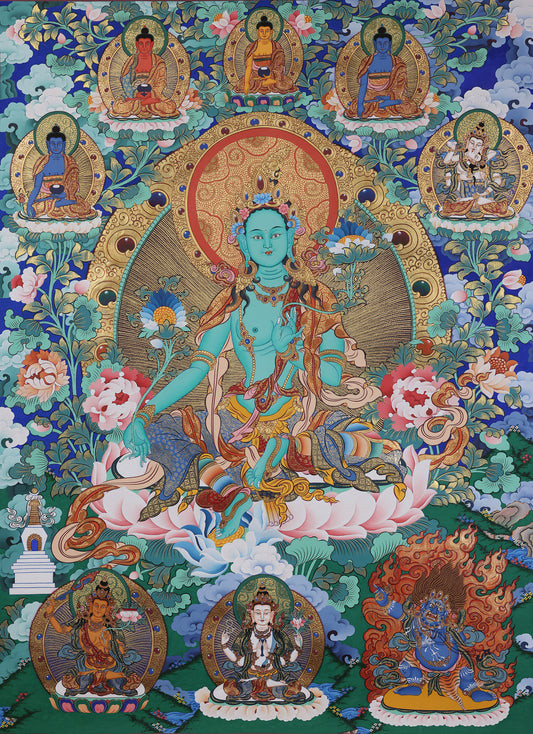
The core theme of this thangka is the Refuge Field of Padmasambhava, representing the most iconic “central point of refuge” in the Nyingma tradition of Tibetan Buddhism. In Tibetan Buddhist contexts, a “refuge field” is not merely an image of a single deity; rather, it integrates successive lineage masters, Buddhas, Bodhisattvas, principal deities, and protective spirits into a single composition. This structure forms a “field of merit” for practitioners, embodying the spiritual concept of accumulating all supreme virtues in one sacred space.
Padmasambhava, as the founder of the Nyingma school, entered Tibet in the 8th century at the invitation of King Trisong Detsen. He established Samye Monastery, ordained the “Seven Vajra Masters,” and integrated Indian tantric teachings with indigenous Tibetan beliefs. Revered as Guru Rinpoche (“Precious Master”), he embodies the essence of tantric mastery and enlightened guidance. The Refuge Field thangka places him at the center, visually representing the threefold blessing of body, speech, and mind, reflecting both devotion to Padmasambhava himself and veneration of the lineage he established.
2. Main Deity Iconography: Rituals and Symbolism of Padmasambhava
a. Appearance and Attire
The central figure, Padmasambhava, strictly adheres to the canonical proportions described in the Sutra of Proportions for Sacred Images and Nyingma ritual guidelines. Every detail conveys profound religious symbolism:
-
Crown and Headgear: The lotus crown (also called the king’s crown) signifies his dual role as an awakened Buddha and sovereign guide of beings.
-
Garments: The inner cross-collared monk’s robe and outer half-moon silk cape, dominated by red and blue, represent the integration of wrathful and compassionate aspects of tantric practice, while reflecting traditional Tibetan color codes denoting noble status.
-
Complexion and Expression: The skin tone, a white with subtle reddish undertones, combines serenity and authority. Slightly furrowed brows convey power, while a peaceful visage radiates compassion, reflecting his function of subduing negative forces and guiding sentient beings.
b. Ritual Implements and Mudras
-
Left hand holding the Kapala bowl: Filled with the “nectar of immortal wisdom,” symbolizing the use of emptiness wisdom to transcend attachment and the cycle of life and death.
-
Left elbow carrying the Khaṭvāṅga (staff): Padmasambhava’s primary tantric implement, featuring a cross-shaped vajra, a vase, three human heads, and flaming prongs. Each element embodies cosmic order and spiritual attainment: the cross vajra represents Mount Sumeru and the five elements (earth, water, fire, wind, space); the vase signifies completeness and nectar; the three heads (red, green, white) denote the elimination of greed, hatred, and ignorance, and symbolize the integration of the emanation, enjoyment, and Dharmakaya bodies.
-
Right hand holding the five-pointed vajra: Extending into the void with a wrathful mudra, it symbolizes the destruction of obstacles and demons along the path, as well as the wisdom of the Five Dhyani Buddhas.
c. Lotus Throne and Halo
Padmasambhava sits in a royal posture (semi-lotus) on a double-layered lotus throne:
-
Lower layer deep pink petals: Represent purity arising unstained from the mud.
-
Upper layer white petals: Symbolize the pure state after awakening.
His halo and body aura are rendered in gold leaf and mineral pigments: the inner layer of red flames signifies wisdom burning away defilements; the outer layer of seven-colored auspicious clouds represents celestial realms; the golden border accentuates sanctity, lending the composition majesty and visual depth.
3. Attendant Deities: Visualizing Lineage and Protective Circles
The Refuge Field thangka encompasses not only the main deity but also attendant figures, forming the lineage hierarchy and protective circle of the Nyingma school.
a. Upper Deity
Above Padmasambhava’s head is often a small depiction of Amitabha Buddha, representing his Dharmakaya source. As the emanation of the body, speech, and mind of Amitabha, Padmasambhava embodies the ultimate awakened essence.
b. Side Attendants
-
Left: Jangchub Chokyi (Shingmo) Master: Wearing red robes and holding ritual implements, a companion of Padmasambhava upon entering Tibet, symbolizing the transmission of exoteric teachings.
-
Right: Yeshe Tsogyal: White-robed, hands in Anjali mudra, Padmasambhava’s principal disciple and consort, representing the upaya (skillful means) of tantric practice and the origin of the Dakini lineage in Nyingma.
c. Lower Offerings and Protector Deities
Beneath the lotus throne, offerings and flowers symbolize worldly and transcendent devotion. Wrathful minor deities such as Vajrakila may appear, representing protection of teachings and removal of obstacles—a functional aspect of the Refuge Field ensuring spiritual progress.
4. Painting Techniques: A Masterpiece of Newar and Menri Styles
This thangka represents a fusion of Nepalese Newar painting and Tibetan Menri school craftsmanship, exemplifying the integration of faith and art.
a. Canvas and Pigments
-
Canvas Preparation: Thick white cotton is processed through six steps: washing, stretching, sizing, priming, coarse grinding, and fine grinding. Each layer is air-dried to ensure pigment adhesion and longevity.
-
Mineral Pigments: Natural pigments such as azurite (blue), malachite (green), cinnabar (red), and gold leaf are used. Azurite represents emptiness, cinnabar signifies compassion, and gold symbolizes the eternal light of the Dharma.
b. Linework and Shading
-
Iron-line and filigree line techniques: Iron-line for robes and implements, precise and bold; filigree for clouds and floral patterns, delicate as silk.
-
Shading: Combination of dry and wet washes creates natural skin tones and vivid robe textures, providing depth and dynamism.
c. Gilding and Eye-Opening
-
Gilding: Gold powder mixed with adhesive is applied to ritual implements, robes, and auras, then burnished to achieve a radiant, sacred effect.
-
Eye-Opening Ceremony: The final ritual, conducted by the artist or a high lama, involves painting the pupils with ink after purification rites and prayers, animating the deity and transforming the thangka from artwork to spiritual vessel.
5. Cultural Significance: A Visual Encyclopedia of Tibetan Faith
The Refuge Field of Padmasambhava thangka is more than an art piece; it is a visualization of Tibetan Buddhist faith. It records Nyingma lineage, ritual procedures, and doctrinal teachings, serving as a miniature “encyclopedia of Tibet.”
-
From an artistic perspective: The composition balances fullness without clutter, combining mineral pigments with gold leaf, and integrating iron-line and filigree techniques, exemplifying Newar-Menri fusion.
-
From a spiritual perspective: Practitioners use it for visualization and receiving blessings, making it a crucial tool in pursuing awakening and liberation. Its enduring cultural and religious relevance underscores the inseparability of art and devotion in Tibetan Buddhism.
#Padmasambhava #GuruRinpoche #TibetanThangka #RefugeField #NyingmaBuddhism #HandPaintedArt #BuddhistArt #SacredArt #SpiritualPractice #SpiritualPractice#TantricDeities #MeditationTools #HimalayanArt #CulturalHeritage #BuddhistSymbolism
Tags:
Previous
Samantabhadra in Tibetan Buddhism: Great Vows and the Esoteric Meaning of the Dharmadhatu in Thangka Art
Next
Hand-Painted Tibetan Buddhist Thangka: Guru Rinpoche’s Refuge Realm – Faith Narrative and Artistic Code