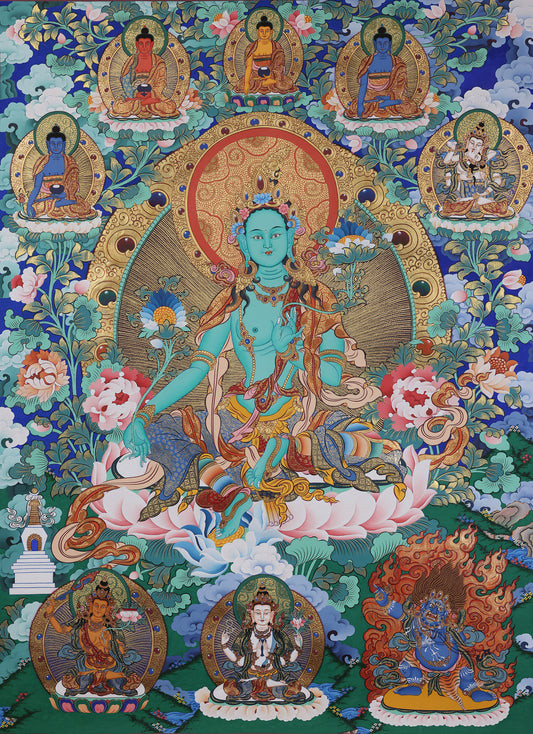
Hand-Painted Four-Armed Avalokiteshvara Mandala Thangka The Spiritual Essence of Tibetan Compassion and Regong Sacred Art

In the artistic system of Tibetan Buddhism, a thangka is never merely a decorative religious painting. It is a visual vehicle of practice, a sacred medium through which doctrine, meditation, and spiritual energy are transmitted. Among all deity themes, the Four-Armed Avalokiteshvara (Chenrezig) Mandala Thangka represents one of the most complete, profound, and practically oriented visual expressions of the Tibetan Buddhist understanding of compassion.
This hand-painted Four-Armed Avalokiteshvara Protective Mandala Thangka, created in the classical Regong tradition, embodies the core Vajrayana teaching of compassionate activity united with wisdom and merit. It functions both as a sacred support for visualization practice and as a refined cultural expression of the Tibetan principle that faith and art are inseparable.
I. Core Theme: A Compassion-Centered Vajrayana Practice System
The central theme of this thangka can be summarized as “The Compassionate Vow Power and Protective Network of Four-Armed Avalokiteshvara.”
Within Tibetan Buddhism, devotion to Avalokiteshvara is not a simple continuation of Indian Buddhism, but a deeply localized spiritual tradition. In the Tibetan cultural world, Four-Armed Avalokiteshvara is revered as the “Protector of the Snow Land”, the personification of boundless compassion and the spiritual guardian of all beings.
By depicting Avalokiteshvara together with attendant deities, protectors, and auspicious symbols in a mandala structure, the thangka establishes a complete practice system centered on compassion, supported by wisdom, merit, and protective forces. This structure accords precisely with Vajrayana ritual logic—principal deity, retinue, and guardians—while simultaneously addressing the practitioner’s aspiration for liberation from suffering and inner stability in daily life.
From a doctrinal perspective, the theme contains three essential layers:
First, the four arms symbolize the four enlightened activities—pacifying suffering, increasing virtue, magnetizing beings, and subjugating afflictions—indicating that compassion can respond to every form of human need.
Second, the mandala composition, with the principal deity at the center and attendants surrounding, reflects the Vajrayana path in which realization arises through a harmonious network of supportive conditions.
Third, the thangka itself functions as a meditation instrument. Through focused contemplation of the image, the practitioner aligns their mind with Avalokiteshvara’s compassionate vow, embodying the Vajrayana principle of “teaching through form, transmitting truth through image.”
II. The Principal Deity: Ritualized Iconography of Compassion and Purity
At the center of the composition stands Four-Armed Avalokiteshvara (Chenrezig), one of the most important bodhisattvas in Tibetan Buddhism. The iconography strictly follows the Iconometric Treatises and classical Avalokiteshvara Sadhanas. Every detail serves as a visual articulation of Buddhist doctrine rather than mere aesthetic choice.
1. Body and Crown: Compassion Rooted in Wisdom
The deity’s body is luminous white, resembling moonlight, symbolizing innate purity and freedom from both emotional and cognitive obscurations. The Five-Buddha crown represents the wisdom blessings of the Five Tathagatas, emphasizing that Avalokiteshvara’s compassion is grounded in ultimate wisdom, not sentimental emotion. Amitabha Buddha, enshrined at the crown, confirms Avalokiteshvara’s lineage origin and points to the aspiration for rebirth in the Pure Land through compassionate devotion.
2. Mudras and Attributes: How Compassion Operates
The two central hands join at the heart, holding a wish-fulfilling jewel, symbolizing the union of wisdom and skillful means. The upper right hand holds a crystal mala, signifying ceaseless compassionate activity to liberate sentient beings. The upper left hand holds an eight-petaled white lotus, representing purity amidst samsaric existence and the ability to guide afflicted beings without contamination.
3. Posture and Throne: Abiding in Stillness Within Samsara
Avalokiteshvara sits in full vajra posture upon a thousand-petaled lotus and moon disc. The posture represents unwavering meditative stability; the lotus symbolizes transcendence of defilement; the moon disc conveys cooling compassion that soothes the heat of suffering. Together, they express the bodhisattva ideal of remaining pure within a defiled world while tirelessly benefiting all beings.
III. Attendant Deities and Auspicious Elements: The Compassionate Support Network
Surrounding the principal deity is a complete mandala of compassionate support, structured according to Vajrayana cosmology.
Upper Deities: Lineage and Source of Blessings
At the top appear Amitabha Buddha (center), White Tara (left), and Green Tara (right). Amitabha establishes the doctrinal lineage, while the Taras—believed to arise from Avalokiteshvara’s tears—represent the active manifestations of compassion. White Tara governs longevity and pacification; Green Tara governs accomplishment and protection, together forming a balanced triad of compassionate activity.
Lower Protectors: Merit and Obstacle Removal
At the bottom, Yellow Jambhala serves as the guardian of merit and resources—not worldly wealth, but the supportive conditions necessary for spiritual practice. The wrathful protector subdues inner and outer obstacles, demonstrating that true compassion includes the forceful removal of ignorance and afflictions.
Decorative Motifs: Visual Extensions of Doctrine
Endless lotus vines signify unceasing compassion; verdant foliage symbolizes vitality awakened through compassion; swirling clouds indicate compassion pervading boundless space. These elements ensure that every portion of the thangka communicates spiritual meaning.
IV. Regong Hand-Painting: The Union of Ritual Precision and Artistic Mastery
This thangka is a masterpiece of pure hand-painted Regong tradition, where craftsmanship is inseparable from spiritual discipline.
From the preparation of three-year-aged cotton canvas, to millimeter-accurate iconometric sketching; from the grinding of 108 natural mineral pigments to the meticulous application of iron-line and gold-line drawing; to the final eye-opening (consecration) ritual, every stage embodies devotion, concentration, and reverence.
Regong thangka art is not merely refined—it is sanctified through practice.
Conclusion: A Living Vessel of Compassion
This hand-painted Four-Armed Avalokiteshvara Protective Mandala Thangka is far more than a religious artwork. It is a living embodiment of compassion, a meditative support, and a cultural legacy. The principal deity represents compassion itself; the retinue provides supportive conditions; and the Regong craftsmanship serves as the sacred vessel.
When one gazes upon this thangka, one encounters not only extraordinary artistry, but also the enduring spiritual path of Tibetan Buddhism:
Facing suffering with compassion, transcending affliction through wisdom.
#FourArmedAvalokiteshvara
#ChenrezigThangka
#AvalokiteshvaraMandala
#TibetanBuddhistThangka
#BodhisattvaArt
#HandPaintedThangka
#RegongThangka
#TraditionalThangkaArt
#SacredBuddhistArt
#TibetanReligiousPainting
#CompassionPractice
#VajrayanaBuddhism
#MeditationMandala
#SpiritualVisualization
#BuddhistMeditationArt
#HomeShrineArt
#MeditationSpaceDecor
#YogaAndHealingSpace
#SpiritualArtCollectors
#MindfulnessDecor
Tags:
Previous
Hand-Painted Four-Armed Avalokiteshvara Thangka: A Spiritual Mirror of Tibetan Compassion and the Art of Rebgong
Next
Hand-Painted Four-Armed Avalokiteshvara Compassion Mandala Thangka A Spiritual Symbiosis of Tibetan Esoteric Faith and the Regong Artistic Tradition