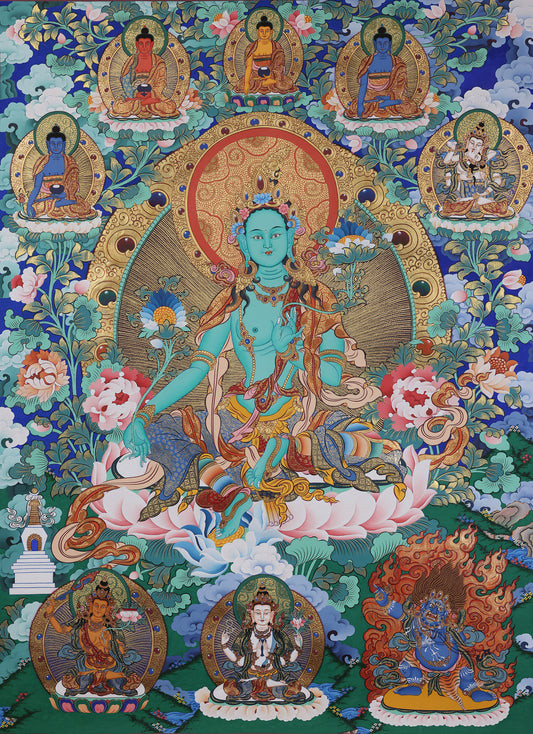
The Pinnacle of Tibetan Black-Gold Thangka: Why This "Eastern Akshobhya Buddha" Is a Dual Treasure for Practice and Collection
wudimeng-Nov 30 2025-
0 Kommentare
If you’ve browsed Tibetan thangka markets or dabbled in Vajrayana art, you’ve definitely heard of "black-gold thangkas"—the "understated luxury" of Tibetan Buddhist art. Today, we’re diving into this hand-painted Eastern Akshobhya Buddha Thangka, where "solemnity" and "spiritual power" are woven into every stroke.
The moment you unfold this thangka, you’ll be drawn to its blue-gold-black color contrast:
- The main deity’s deep azure hue isn’t just any pigment—it’s "Buddha-body blue" made from ground lapis lazuli (a Tibetan painter’s signature material), corresponding to the Eastern Akshobhya Buddha’s sacred color, symbolizing freedom from anger and unwavering dharma nature.
- The interwoven lotus vines, auspicious clouds, and dharma wheels are hand-painted with 24K gold leaf mixed with gold powder. Set against the black background, they exude regal grandeur—each scrollwork pattern takes a painter 3 hours of steady-handed work, the mark of a true "handcrafted thangka."
- Even the lotus throne’s petal lines follow Vajrayana iconographic rules: every curve and layer adheres to the Iconographic Measurements Sutra’s specifications for "Akshobhya’s pure land."
Many people collect thangkas for aesthetics, but connoisseurs focus on the deity’s vows—this thangka centers on the "Eastern Akshobhya Buddha":
- His blue form is a "code for overcoming anger": Akshobhya’s core vow is, "May no one who sees me harbor resentment"—if you struggle with emotional reactivity or anger, this Buddha’s blessing acts like an "emotional stabilizer."
- The vajra (in his right hand) and meditative mudra (in his left) are symbolic: the vajra represents smashing delusions and fortifying bodhicitta; the meditative mudra embodies concentration and the mirror-like wisdom (one of the Five Wisdoms associated with Akshobhya). It’s why Tibetan practitioners enshrine Akshobhya thangkas in their meditation rooms.
Tibetan thangkas come in many styles, but black-gold thangkas are "valuable and in demand":
-
Material costs alone are steep: Lapis lazuli, gold leaf, and mineral black pigment make up 60% of the total cost.
-
Painter expertise is non-negotiable: Only "black-gold painters" with 10+ years of experience can create these—each piece takes 30–45 days to complete.
-
Its meaning hits a modern nerve: Akshobhya’s focus on "calming anger and stabilizing the mind" resonates with today’s emotional struggles—one reason black-gold thangkas are trending in Tibetan-style homes and spiritual spaces.
Don’t fall for machine-printed fakes! Here’s how to verify this thangka:
-
Check the gold lines’ "texture": Hand-painted gold strokes have natural brushwork; machine-printed ones are rigid and smooth.
-
Feel the pigment’s "granularity": Mineral pigments have subtle texture; chemical pigments feel flat.
-
Look for the "painter’s personal seal": Authentic handcrafted thangkas bear the artist’s unique seal (not a mass-produced stamp) in the bottom right corner.
Whether you want to add a "mind-stabilizing" thangka to your meditation space or collect a heirloom-worthy piece of Tibetan art, this Eastern Akshobhya Black-Gold Thangka checks all boxes: beauty, blessing, and collectible value. After all, only Tibetan thangkas turn "emotional healing" into a work of art.