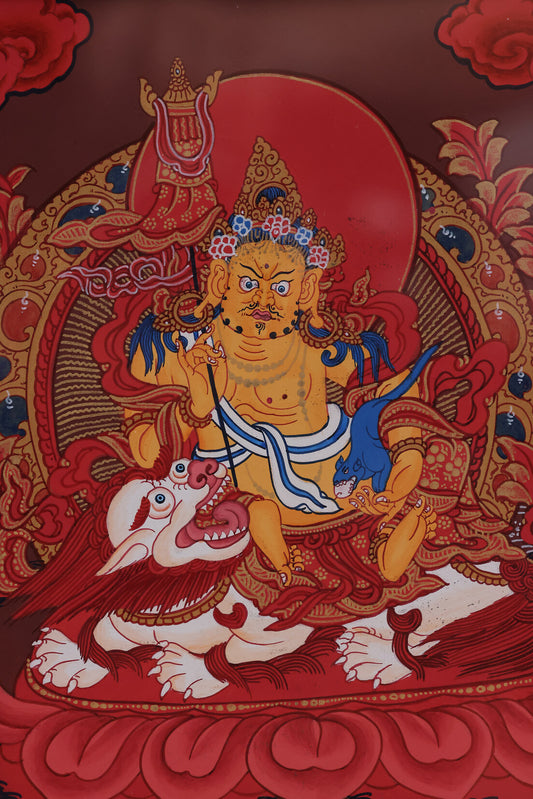
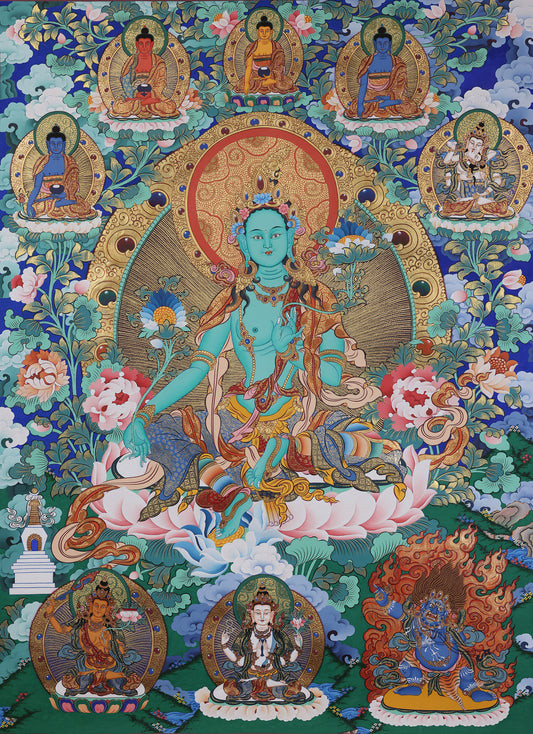
When a 20×30cm vermilion-based thangka is laid out on a desk, what you see is not just the delicate brushwork of a Nepalese artist, but the spiritual condensation of "wealth and protection" in Tibetan Buddhist faith—this is the Nepalese Hand-Painted Red Thangka of Vaishravana, a miniature artistic sanctuary built with mineral pigments as its backbone and religious iconography as its soul.
In the Tibetan Buddhist pantheon, "Vaishravana" is never merely a "god of wealth."
His prototype is Kubera, the leader of yakshas in Hinduism, who was reimagined in Tibet as the "Northern World Protector King"—he both oversees the fair distribution of worldly wealth and guards Buddhist practitioners against obstacles and poverty. The "Red Thangka" format of this work is itself a visual footnote to faith: the vermilion background, made from cinnabar, corresponds to "life energy" and "evil warding" in Tibetan Buddhism, turning this piece into both a vessel for wealth wishes and a protective 结界 (spiritual barrier) for space and the mind.
For believers, enshrining this thangka means praying for abundant wealth while binding its acquisition to the "pure karma" of Dharma—the upturned and downturned lotus petals of the red lotus seat already imply that "wealth should rise unsoiled from the mud."
Every detail of Vaishravana at the center of the thangka adheres to the sacred norms of the Iconometric Sutras, yet carries the vitality of the Nepalese Newari school:
-
Form: The warm yellow body corresponds to the "incarnation of Ratnasambhava Buddha." His slightly wrathful eyebrows, eyes, and stubble embody the divine identity of "guarding compassion with majesty"—deterring obstacles while retaining care for all beings;
-
Implements: The victory banner held high in his right hand is a symbol of authority over "governing wealth from all directions + protecting Dharma’s victory"; the treasure-spitting mongoose (Marici) held in his left hand, with a jewel in its mouth, is a direct metaphor for "endless wealth"—rooted in Hinduism but redefined in Tibetan Buddhism as a symbol of "fulfilling virtuous wishes";
-
Mount: The red-maned snow lion roars backward, a symbol of "strength and protection" in Tibetan culture and a concrete manifestation of "deterring obstacles to wealth."
These elements are not decorative; they are the traditional "visualization of divine identity" in Tibetan Buddhism—every line and color is a language of faith.
In the 20×30cm space, attendant deities are hidden in details through metaphor:
The "Eight Horse Gods" (attendants of Vaishravana) do not appear fully as "eight figures riding white horses." Instead, their role of "spreading wealth across the eight directions" is implied by the "treasures spilling from the mongoose’s mouth"; the faint horse-head outlines in the background scrollwork are a unique Nepalese thangka technique of "hiding attendants in details."
The small blue beast beside the main deity and the treasure bowl pattern under the lotus seat are guardian symbols for "protecting wealth from loss," perfectly complementing the main deity’s functions.
The value of this thangka lies in every traditional process:
-
Canvas: White cotton cloth is washed with alkaline water, repeatedly coated and polished with ox bone glue + white clay, then stretched over an iron frame—its paper-smooth surface is the foundation for detailed painting;
-
Pigments: Vermilion red, realgar yellow, lapis lazuli blue, and Rinpung white clay are all natural minerals and earth materials—lapis lazuli’s deep blue is a precious tribute from Afghanistan; 24K gold leaf ground into powder gives the banner and ornaments a warm glow against the vermilion background, resisting fading for centuries;
-
Painting: From "pre-painting chanting and visualization" to "drafting and line-setting," from "layered glazing" to "outlining and eye-opening," each stroke over 1–2 months carries the artist’s vows and reverence—the final "eye-opening" brushstroke is a sacred ritual of "bestowing divine identity."
This is not "painting"—it is a Nepalese artisan’s tribute to faith through material and technique.
The "beauty" of this thangka is the signature expression of the Nepalese Newari school:
-
Color: Vermilion as the base, with contrasting yet harmonious gold, yellow, and blue—aligning with the religious logic of "five colors corresponding to the five Dhyani Buddhas" while embodying the Newari school’s "bold and vivid" artistic character;
-
Composition: A centrally focused layout, with the main deity occupying 80% of the space and attendants/background simplified and integrated—achieving "density and balance, emphasizing divine identity" in a small format;
-
Brushwork: Hair-thin lines outline ornament details and lion manes, while jewel luster is rendered with "gold line highlighting + mineral glazing"—upholding iconographic rigor without losing artistic vitality.
It differs from the simplicity of Tibetan thangkas and the vibrancy of Rebkong thangkas, embodying the Newari school’s hallmark of "coexisting grandeur and solemnity."
The 20×30cm format holds the spiritual core of Tibetan Buddhism, the millennia-old heritage of Nepalese traditional craftsmanship, and the stylistic identity of Newari art.
It is a vessel for believers’ wishes on their desks, a visual textbook for practitioners to understand "wealth and virtuous karma," and a miniature specimen of "coexisting faith and art" in the Himalayan cultural sphere—every mineral pigment line is a cultural gene.
#NepaleseThangka #RedThangkaVaishravana #TibetanBuddhistArt #MineralPigmentThangka #NewariArtSchool