1. Core Theme: The Faith Loop of “Compassion Everywhere”
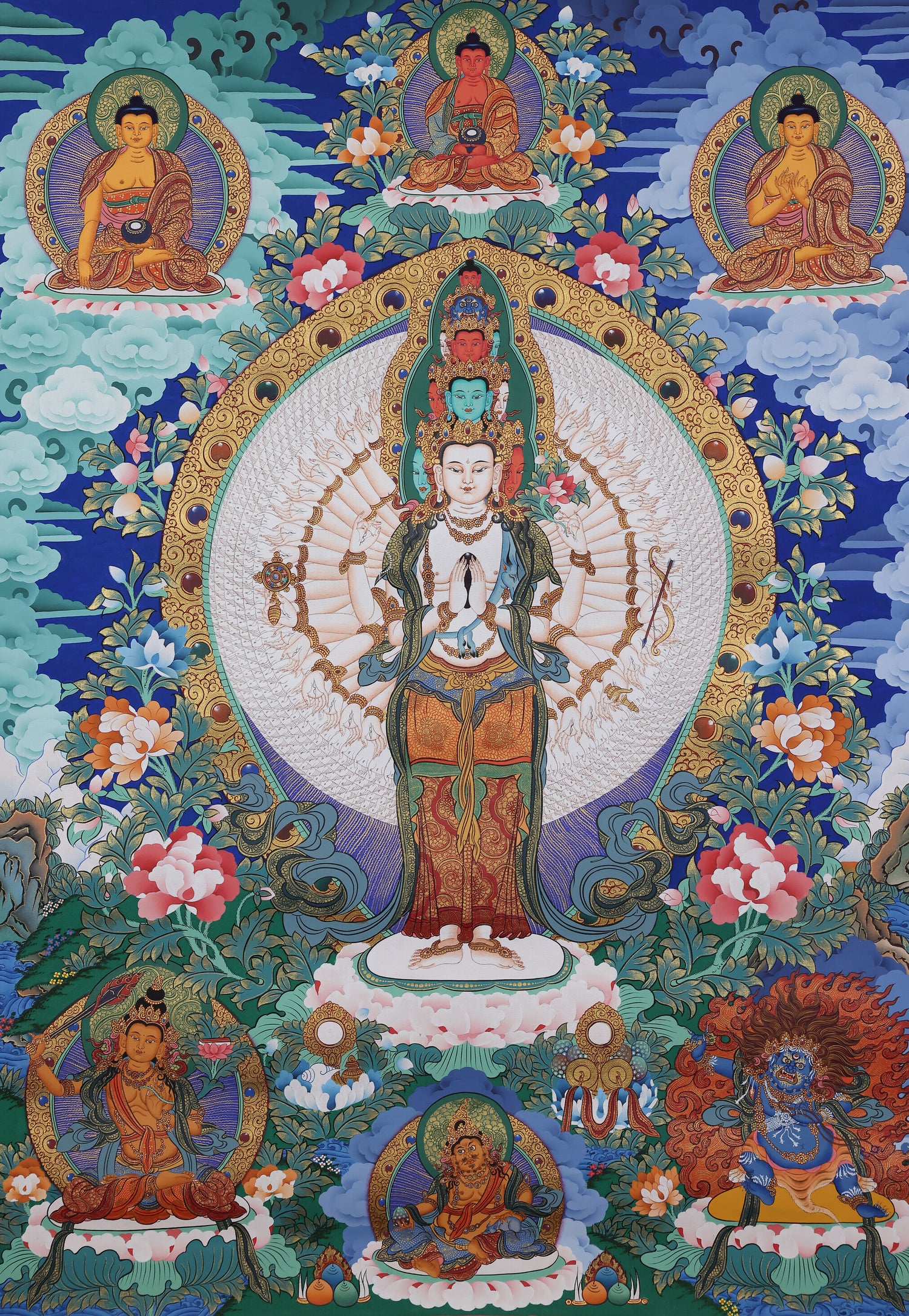
The central theme of this Thangka is the Eleven-Faced, Thousand-Armed, Thousand-Eyed Avalokiteshvara (Tibetan: Kye-rhot-se), a visual embodiment of the Tibetan Buddhist doctrine of “Compassion as the foundation, skillful means as the method.” In Tibetan tradition, Avalokiteshvara is revered as the “Protector of the Snowland,” while the Thousand-Armed and Thousand-Eyed manifestation represents the culmination of boundless compassion—when Avalokiteshvara witnessed the endless suffering of sentient beings, his body split into a thousand pieces. With Amitabha Buddha’s divine power, he was reconstituted into the Eleven-Faced, Thousand-Armed, Thousand-Eyed form, symbolizing “supporting sentient beings with infinite hands and perceiving suffering with infinite eyes,” completing the faith loop of compassion → vow → salvation.
This Thangka is not merely an image; it constructs a spiritual link of individual suffering → Avalokiteshvara’s salvation → worldly completion. The thousand arms and eyes of the central deity correspond to the limitless afflictions of sentient beings, attendant deities represent diverse methods of salvation, and the artistic craftsmanship itself embodies “using art to convey dharma,” making it a spiritual vessel for practitioners to cultivate compassion and seek liberation.
2. Central Deity: Symbolism and Doctrinal Allegory of Eleven-Faced, Thousand-Armed Avalokiteshvara
The central deity follows strict guidelines from the Canonical Text on Proportions of Images and the Secret Tantra of Avalokiteshvara, with every detail representing a tangible expression of religious philosophy.
Eleven Faces: Layered Manifestation from Compassion to Wrath
-
Lower three faces (white, green, red): Calm compassionate expressions representing the Jewel Section (removing karmic obstacles), Lotus Section (embracing beings with kindness), and Vajra Section (subduing afflictions).
-
Middle three faces (green, red, white): Echo lower faces, symbolizing universal compassion, rescuing beings in the three lower realms.
-
Upper face: Fierce wrathful expression (black hair, fangs) to destroy arrogance and attachment.
-
Top face: Amitabha Buddha’s serene red face, indicating Avalokiteshvara as a manifestation of Amitabha’s compassion, and symbolizing the ultimate union of compassion and wisdom.
This eleven-faced arrangement reflects the salvific logic from compassion to wrath, from mundane to sacred wisdom, embodying the Vajrayana principle of responding to beings according to their capacities.
Thousand Arms and Eyes: Dual Extremes of Compassion and Wisdom
-
Thousand Arms: Represent limitless skillful means. Some hands hold lotus flowers (purity), vases (blessing), dharma wheels (turning the wheel of Dharma), and bows and arrows (subduing afflictions), corresponding to the fulfillment of diverse wishes.
-
Thousand Eyes: Symbolize omniscient wisdom, with each hand’s eye perceiving subtle suffering, illustrating the integration of compassion and wisdom.
This hands-and-eyes integration elevates compassion from mere emotion to an active, wisdom-centered practice of salvation.
Form and Lotus Throne: Spatial Metaphor of Purity and Salvation
The deity’s sky-blue body (the hallmark color of Tibetan Avalokiteshvara) symbolizes boundless compassion like the sky. Draped in celestial robes and adorned with jewelry, the ornamentation alludes to the diverse methods of salvation. The double-layered lotus throne: the lower petals represent worldly suffering, the upper petals symbolize purity emerging from the mud, embodying the doctrine of “guiding beings across the ocean of suffering.”
3. Attendant Deities: Hierarchical and Functional Collaboration in Salvation
The Thangka’s attendant deities represent the microcosm of the Tibetan “Three Roots – Dakinis – Protectors” system, illustrating the logic of core deity → assisting deities → protective guardians.
1. Wisdom and Power: Principal Attendants
-
Manjushri (holding the sword of wisdom): Embodies wisdom, complementing Avalokiteshvara’s compassion to create a compassion-wisdom synergy.
-
Vajrapani (holding the vajra): Represents power, corresponding to Avalokiteshvara’s wrathful aspect, symbolizing the subjugation of obstacles.
Together, the Three Roots illustrate the Tibetan Buddhist principle: compassion as the foundation, wisdom as guidance, and power as method, emphasizing that Avalokiteshvara’s salvation requires both wisdom and strength.
2. Female Manifestations: Compassion’s Feminine Extension
-
Green Tara (holding a lotus): Swiftly rescues suffering beings, reflecting Avalokiteshvara’s vow of hearing and responding.
-
White Tara (holding a vase): Protects longevity and health, highlighting Avalokiteshvara’s function in relieving worldly suffering.
These deities materialize universal compassion into targeted salvation, providing a spiritual foundation for practitioners seeking stability and relief in daily life.
3. Background Elements: Cosmic and Auspicious Integration
-
Deep blue background: Symbolizes the space of the three realms, reflecting Avalokiteshvara’s compassion pervading the cosmos.
-
Floral motifs and clouds: Variations of the Eight Auspicious Symbols, combined with Chinese Gongbi painting techniques, symbolize worldly completion and the continual renewal of nature, implying the constancy of Avalokiteshvara’s salvation.
4. Artistic Craftsmanship: The Practice of “Using Art to Manifest Compassion”
1. Canvas Preparation: Purification and Transformation
Using pure cotton cloth, layered with glue, gesso, and powdered base, polished with stones, the canvas transforms from mundane to sacred, representing the removal of worldly roughness to become a pure land carrying the compassionate deity.
2. Pigments: Coexistence of Nature and Faith
-
Sky-blue body: Made from lapis lazuli, enduring over 200 years, symbolizing the eternal compassion of Avalokiteshvara.
-
Gold lines: 24K gold leaf, mixed with saffron and glue, outline robes and implements, representing the indestructibility of the deity’s vow.
-
Red, green, white faces: Derived from ochre, malachite, and chalk, corresponding to the Five Buddha Families, expressing doctrine through color.
3. Painting Process: Unity of Ritual and Skill
-
Pre-sketch: The artist bathes, observes vows, and recites the Avalokiteshvara mantra, possibly performing tantric initiation to transform the hand into a tool of compassion.
-
Sketching and Outlining: Strict adherence to the eleven-face proportions, thousand-hand symmetry, and iron-line technique, respecting the sacredness of the deity.
-
Layered Coloring and “Opening the Eyes”: Gradual layering from light to dark, finishing with the soul-defining “opening of the eyes,” signifying Avalokiteshvara awakening in the image and connecting spiritually with the viewer.
4. Art Style: Realizing Compassion through the Rebgong School
The Rebgong School is renowned for vivid colors, intricate gold lines, and silk-like precision, perfectly showcasing the radiant thousand arms and eleven faces. Background landscapes blend Chinese Gongbi techniques, creating a gentle and approachable compassionate expression, demonstrating the Rebgong School’s principle of conveying the warmth of compassion through art.
5. Conclusion: Thangka as a “Living Vessel of Compassion”
This Thousand-Armed, Thousand-Eyed Avalokiteshvara Thangka is a three-dimensional textual representation of Tibetan Buddhist compassion:
-
Theme: Culmination of the vow of compassion
-
Deity System: Hierarchical visual manifestation of salvation
-
Craftsmanship: Practice of “art as dharma in motion”
For practitioners, it serves as a meditation focus and refuge in suffering; for scholars, it embodies a microcosm of Tibetan cosmology, aesthetics, and ethics. Every mineral pigment and gold line transforms abstract teaching into tangible experience, creating a spiritual warmth that transcends a millennium, carrying the eternal value of wisdom and compassion.
#ThousandArmedAvalokiteshvara#ElevenFacedAvalokiteshvara#TibetanThangka #HandPaintedThangka #BuddhistArt #Avalokiteshvara #MeditationArt #Compassion #RebgongSchool #SpiritualArt #BodhisattvaThangka #SacredArt #TibetanBuddhistCulture #HomeShrine #MindfulnessArt