Blog Post: Nepali Blue Thangka of Samantabhadra Bodhisattva: Exploring Tibetan Buddhist Devotional Aesthetics and Millennia-Old Craftsmanship

$499.00 USD
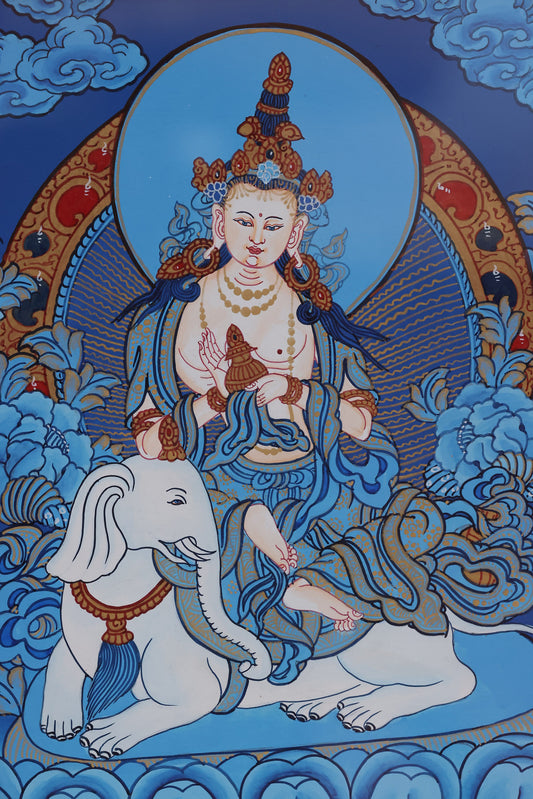
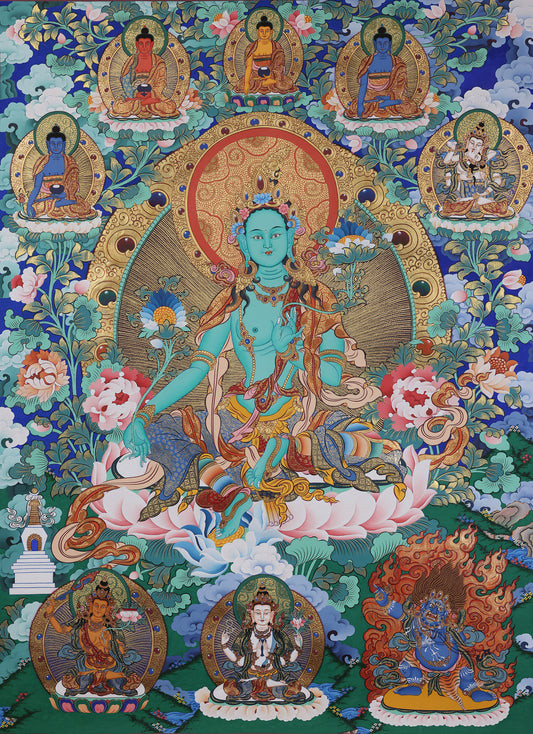
Thangka name: Blue Tang Samantabhadra Bodhisattva
size: 20cm×30cm
origin: Nepal
Eine Frage stellen

Beeil dich! Nur noch [Anzahl] auf Lager!

Geschätzte Lieferzeiten: 12–26 Tage (International), 3–6 Tage (USA).

Rückgabe innerhalb von 45 Tagen nach dem Kauf. Zölle und Steuern werden nicht erstattet.

Blue Thangka of Samantabhadra, the primordial Buddha in Tibetan Buddhist art, representing wisdom and compassion.
Blog Post: Nepali Blue Thangka of Samantabhadra Bodhisattva: Exploring Tibetan Buddhist Devotional Aesthetics and Millennia-Old Craftsmanship
$499.00 USD
In the artistic lineage of Tibetan Buddhism, thangkas are devotional vessels of "liberation upon sight"—and the Nepali blue thangka of Samantabhadra Bodhisattva epitomizes the symbiosis of devotion and craftsmanship in the Himalayan cultural sphere. Today, we focus on a 20×30cm hand-painted Nepali blue thangka: crafted with mineral and earth pigments, it embodies Samantabhadra’s "great vow-powered action" while holding the aesthetic codes of the Newari school’s millennial heritage.

I. Theme: Visualizing "Wisdom Through Action"

The core of this thangka lies in Samantabhadra Bodhisattva’s "Virtue of Great Action"—as one of the "Three Saints of the Avataṃsaka Sūtra," Samantabhadra (paired with Manjushri’s "Virtue of Wisdom") symbolizes the path of spiritual practice that "validates wisdom through action." The ten great vows in the Samantabhadra’s Aspiration form the thangka’s spiritual core: from "revering all buddhas" to "dedicating all merits universally," Samantabhadra’s vows are translated into visual symbols, guiding practitioners to "enter the path through action."

Its choice of a blue background (defining it as a "blue thangka") aligns with Tibetan Buddhist philosophical expression: blue corresponds to the "void of the dharma realm," echoing Samantabhadra’s intrinsic nature of "pervading all worlds" while conveying the Madhyamaka ideals of "stillness and emptiness" through its cool hue. Within the 20×30cm space, the blue backdrop acts as a cosmic canvas, expanding Samantabhadra’s "great vow-powered action" into a tangible devotional field.

II. Main Deity Iconography: A Symbolic System Rooted in Ritual

Tibetan thangka iconography is never arbitrary—every detail of Samantabhadra’s form adheres to the Iconometric Canon while carrying devotional metaphors:

1. Physiognomy: Unity of Merit and Dignity

The bodhisattva’s face features the Newari school’s iconic "infant-like roundness": soft, full contours and gentle brows convey the "compassionate, non-angry" serene aspect; the cranial protuberance (urna) signifies "wisdom’s radiance," and the pale golden skin corresponds to "perfect merit"—a concrete manifestation of the "thirty-two marks" of Tibetan bodhisattva iconography.

The five-buddha crown (each jewel representing a buddha: Vairocana at the center, Akshobhya in the east, etc.) symbolizes "guiding sentient beings with buddha wisdom"; the necklaces and wrist bangles, dominated by gold and red, carry layered meaning: gold represents "radiant dignity," while red embodies "compassionate agency"—mirroring Samantabhadra’s dual nature of "vow and action."

2. Implements and Mudra: Codes of Esoteric Protection

Unlike Han Chinese depictions of Samantabhadra holding a ruyi scepter, this thangka shows the bodhisattva forming the dhyana mudra (meditation gesture) while cradling a stupa (or nectar vase). In Tibetan esoteric Buddhism, the stupa symbolizes the "dharma-realm wisdom body," representing Samantabhadra’s "unifying all dharmas with wisdom"; the nectar vase links to the merit of "Samantabhadra’s longevity"—in Nepali folk devotion, Samantabhadra is venerated as a bodhisattva of "health and long life," and this implement visualizes that function.

3. Mount: The Six-Tusked White Elephant’s "Six Perfections" Metaphor

The bodhisattva sits atop a six-tusked white elephant—Samantabhadra’s signature mount: the six tusks correspond to the "six paramitas" (generosity, morality, patience, diligence, concentration, wisdom), symbolizing "upholding vows through the six perfections"; the elephant’s milky-white form, accented with blue and gold patterns, embodies "purity without defilement," while its curled trunk and lotus-treading feet echo the Sutra on the Method of Visualizing Samantabhadra Bodhisattva’s description of "seven limbs touching the ground, sprouting seven lotuses"—the lotuses correspond to the "seven factors of enlightenment," the seven practices for spiritual awakening.

III. Attendants and Composition: Devotional Logic in a Small Frame

The 20×30cm size means this thangka cannot adopt the "dense, all-encompassing" composition of Tibetan thangkas, but Newari artists use symbolic ornamentation to complete the devotional system:

  • The blue-gold auspicious clouds behind the bodhisattva’s nimbus are an iconic representation of "dakinis and offering goddesses"—clouds signify "dharma protector guardianship" in Tibetan culture, while blue lotuses symbolize "untainted wisdom amid afflictions";
  • The red-gold mandala border at the thangka’s edges implies "vajra protector" guardianship: red corresponds to "wrathful protectors," gold to "radiant protectors." Though no concrete figures are depicted, color encodes the devotional loop of "upholding buddha wisdom, guarded below."

This "ornament-instead-of-figure" approach is a hallmark of small Nepali thangkas: within limited space, it honors ritual conventions while maintaining visual simplicity and dignity.

IV. Craftsmanship and Style: A Living Specimen of Millennial Heritage

Half the value of this thangka lies in devotion, the other in craftsmanship—it uses mineral and earth pigments and follows the Newari school’s millennial techniques:

1. Mineral Pigments: Color Codes That Endure Centuries

  • Blue: Sourced from top-grade "first-quality lapis lazuli" (from Afghanistan), purified via the "water-floating method" (grinding and sedimentation) for pure, long-lasting hue;
  • Gold: 24K gold leaf ground into powder, mixed with ox bile for adhesion, yielding thin, uniform gold lines (≈0.15mm) with luster and durability;
  • White: Ground tridacna shell, symbolizing "purity"; Red: A blend of cinnabar and coral powder, conveying "compassionate warmth."

These pigments make the thangka not just art, but a "transmissible devotional vessel"—mineral pigments retain their color for over 300 years, the secret to thangkas’ timeless beauty.

2. Newari Style: Sino-Nepali Fusion Aesthetics

This thangka is a classic work of the Newari school, infused with influences from Tibet’s Gyantse style:

  • Composition: The central bodhisattva occupies 80% of the frame, balanced and uncluttered (unlike Tibetan thangkas’ density), exuding simplicity and dignity;
  • Lines: Fluid, graceful gold lines; robes outlined with "wheat-awn fine brushes," balancing strength and softness;
  • Color: Dominated by blue, gold, and white, with striking warm-cool contrast and natural blending—an inheritance of the Sino-Nepali fusion style developed when Nepali artists traveled to Tibet between the 13th and 15th centuries.

Conclusion: Great Devotion in a Small Thangka

This 20×30cm Nepali blue thangka of Samantabhadra Bodhisattva is a dual crystallization of "devotion and craftsmanship": it takes Samantabhadra’s "great vow-powered action" as its soul, ritual iconography as its framework, mineral pigments as its skin, and Newari style as its charm. Within its small dimensions, it carries Tibetan Buddhist philosophy, Nepali artistic tradition, and the Himalayan cultural sphere’s spirit of "conveying the dharma through beauty."

For practitioners, it is a portable vessel of vow-powered protection; for art lovers, it is a living specimen of millennial craftsmanship—this is the deeper meaning of thangkas’ "liberation upon sight": beauty and devotion are one.

#NepaliThangka #SamantabhadraBodhisattva #TibetanBuddhistArt #BlueThangka #NewariArtSchool #MineralPigmentThangka
Entdecken Sie das perfekte tibetisch-buddhistische Thangka, das zu Ihren Wünschen, Ihrem Lebensstil und Ihrem Raum passt. Jedes Thangka hat eine spirituelle Bedeutung und bringt Segen, wenn es richtig platziert wird.

1. Definieren Sie Ihre Absicht

Reichtum & Erfolg → Gelber Dzambhala (Gottheit des Reichtums)

Mitgefühl und Frieden → Avalokiteshvara, Grüne Tara

Weisheit & Lernen → Manjushri

Gesundheit & Heilung → Medizinbuddha

Langlebigkeit und Familienschutz → Weiße Tara

2. Wählen Sie nach Identität

Unternehmer und Geschäftsinhaber → Reichtumsgottheiten für Wohlstand.

Studenten und Gelehrte → Weisheitsgottheiten für Konzentration und Klarheit.

Heiler und Yoga-Praktizierende → Medizinbuddha für Energie und Gleichgewicht.

Familien und Hausfrauen → Tara-Gottheiten für Harmonie und Sicherheit.

Sammler und Kunstliebhaber → Seltene Mandalas oder Meisterwerk-Thangkas.

3. Passen Sie Ihren Raum an

Heimschrein / Meditationsraum → Mittlere Thangkas (60–80 cm).

Büro / Geschäftshalle → Große Thangkas für Wohlstand und Autorität.

Wohnzimmer / Arbeitszimmer → Dekorative Thangkas für Frieden und Schönheit.

4. Authentische Handwerkskunst

Jedes Thangka ist mit natürlichen Mineralpigmenten und feiner Leinwand handbemalt und spiegelt tibetische Kunstfertigkeit und spirituelle Kraft wider. Überprüfte Quellen gewährleisten Qualität und Respekt für die Tradition.

✨ Wählen Sie Ihr Thangka mit Herz – es ist nicht nur Kunst, sondern ein Segen für Ihr Leben.

Jeder Mensch hat unterschiedliche Bedürfnisse. Die Wahl des richtigen Thangkas kann spirituelle Unterstützung, Schutz, Glück und Segen bieten. Nachfolgend finden Sie Thangka-Empfehlungen für verschiedene Rollen:

1. Unternehmer

  • Bedürfnisse : Weisheit, Reichtum, Gesundheit, beruflicher Erfolg.
  • Empfohlene Thangkas :
    Manjushri : Verbessert die Entscheidungsfindung und Geschäftsweisheit.
    Gottheit des Reichtums : Bringt Reichtum und Wohlstand.
    Medizinbuddha : Unterstützt die Gesundheit und reduziert Stress.
    Mahakala : Schützt Unternehmen vor Konkurrenz und Herausforderungen.

2. Erfolgreiche Einzelpersonen

  • Bedürfnisse : Innerer Frieden, Familienharmonie, Langlebigkeit.
  • Empfohlene Thangkas :
    Amitabha Buddha : Bringt inneren Frieden und Ruhe.
    Avalokiteshvara (Guanyin) : Fördert Harmonie und Glück in der Familie.
    Amitayus (Langlebens-Buddha) : Betet für gute Gesundheit und ein langes Leben.
    Manjushri : Stärkt weiterhin die Weisheit.

3. Hausfrauen/Ehemänner

  • Bedürfnisse : Familienharmonie, Schutz, Gesundheit.
  • Empfohlene Thangkas :
    Avalokiteshvara : Steigert das Familienglück und die Harmonie.
    Schutzgottheiten : Beschützen die Familie vor äußeren Störungen.
    Weiße Tara : Segnet die Familie mit Gesundheit.

4. Studierende und Wissenschaftler

  • Bedürfnisse : Weisheit, Konzentration, akademischer Erfolg.
  • Empfohlene Thangkas :
    Manjushri : Fördert Lernfähigkeit, Gedächtnis und Weisheit.
    Shakyamuni Buddha : Hilft bei der Konzentration und spirituellen Praxis.
    Jixiang Tianmu : Bringt akademisches Glück und Prüfungserfolg.

5. Künstler und Kreativprofis

  • Bedürfnisse : Inspiration, Kreativität, künstlerische Leistung.
  • Empfohlene Thangkas :
    Manjushri : Regt kreatives Denken und Inspiration an.
    Vajrapani : Hilft, kreative Blockaden zu überwinden.
    Maitreya : Sorgt für eine entspannte und optimistische Einstellung und baut Stress ab.

6. Reisende und Abenteurer

  • Bedürfnisse : Schutz, Glück, Erfolg bei Abenteuern.
  • Empfohlene Thangkas :
    Hayagriva : Bietet starken Schutz auf Reisen und beseitigt Hindernisse.
    Mahakala : Bringt Glück und Schutz, insbesondere für Abenteurer.
    Vajrasattva : Hilft, Schwierigkeiten und Herausforderungen während der Reise zu überwinden.

7. Ältere Menschen

  • Bedürfnisse : Gesundheit, Langlebigkeit, spiritueller Frieden.
  • Empfohlene Thangkas :
    Amitayus : Betet für ein langes Leben und gute Gesundheit.
    Medizinbuddha : Fördert Heilung und körperliches Wohlbefinden.
    Avalokiteshvara : Bringt Mitgefühl und inneren Frieden in späteren Jahren.

8. Führungskräfte

  • Bedürfnisse : Führung, Weisheit, Teamarbeit und geschäftlicher Erfolg.
  • Empfohlene Thangkas :
    Manjushri : Verbessert Führungsqualitäten und Entscheidungsfindung.
    Gottheit des Reichtums : Bringt dem Unternehmen und dem Team Erfolg und Wohlstand.
    Avalokiteshvara : Fördert Harmonie und Gleichgewicht innerhalb des Teams.

9. Gesundheits- und Fitnessbegeisterte

  • Bedürfnisse : Gute Gesundheit, Vitalität, Energie.
  • Empfohlene Thangkas :
    Medizinbuddha : Verbessert die körperliche Gesundheit und Vitalität.
    Weiße Tara : Bringt Gesundheit und Verjüngung.
    Vajrasattva : Beseitigt gesundheitliche Probleme und steigert die Energie.

10. Politiker

  • Bedürfnisse : Führung, Weisheit, Frieden.
  • Empfohlene Thangkas :
    Manjushri : Verbessert Führungsqualitäten und Entscheidungsfindung.
    Vairocana Buddha : Hilft, inneren Frieden und Weisheit zu bewahren.
    Avalokiteshvara : Fördert den gesellschaftlichen Frieden und die Harmonie in der Familie.

Für alle Bestellungen über 100 USD ist der Versand kostenlos.

Rücksendungen werden bis zu 10 Tage nach Erhalt des Kaufbelegs bzw. der Sendungsnummer (bei ungetragenen Artikeln) akzeptiert. Sie als Kunde sind verpflichtet, uns vor der Rücksendung des Artikels per E-Mail zu informieren.

Andernfalls fallen die Standardversandkosten an. Weitere Informationen finden Sie in unseren Lieferbedingungen .

Rücksendungen werden bis zu 10 Tage nach Erhalt des Kaufbelegs oder der Sendungsnummer (bei ungetragenen Artikeln) akzeptiert. Sie als Kunde sind verpflichtet, uns vor der Rücksendung des Artikels per E-Mail zu informieren, nur in folgenden Fällen:

– Den falschen Artikel erhalten.
– Artikel kam nicht wie erwartet an (z. B. beschädigte Verpackung).
– Artikel hatte Mängel.
– Über die Lieferzeit hinaus.
– Der Spediteur gestattet keine Besichtigung der Ware vor der Bezahlung.

Die zurückgesendeten Produkte müssen in der Originalverpackung, sicher verpackt, unbeschädigt und ungetragen sein. Dies bedeutet, dass die Artikel zum Schutz während des Transports sicher in einem Karton verpackt sein müssen, möglichst im selben Karton, in dem sie an Sie als Kunde versendet wurden.

Kürzlich angesehen

Nicht vergessen! Die Produkte, die Sie angesehen haben, legen Sie jetzt in den Warenkorb.

Passt gut zu

Erweitern Sie Ihre Auswahl mit perfekt abgestimmtem Zubehör und ergänzenden Produkten.

Leute kauften auch

Hier sind einige unserer ähnlichsten Produkte, die die Leute kaufen. Klicken Sie hier, um den Trendstil zu entdecken.