I. Theme: The Majestic Merit of the Western Pure Land and the Nyingma Interpretation of Pure Land Faith
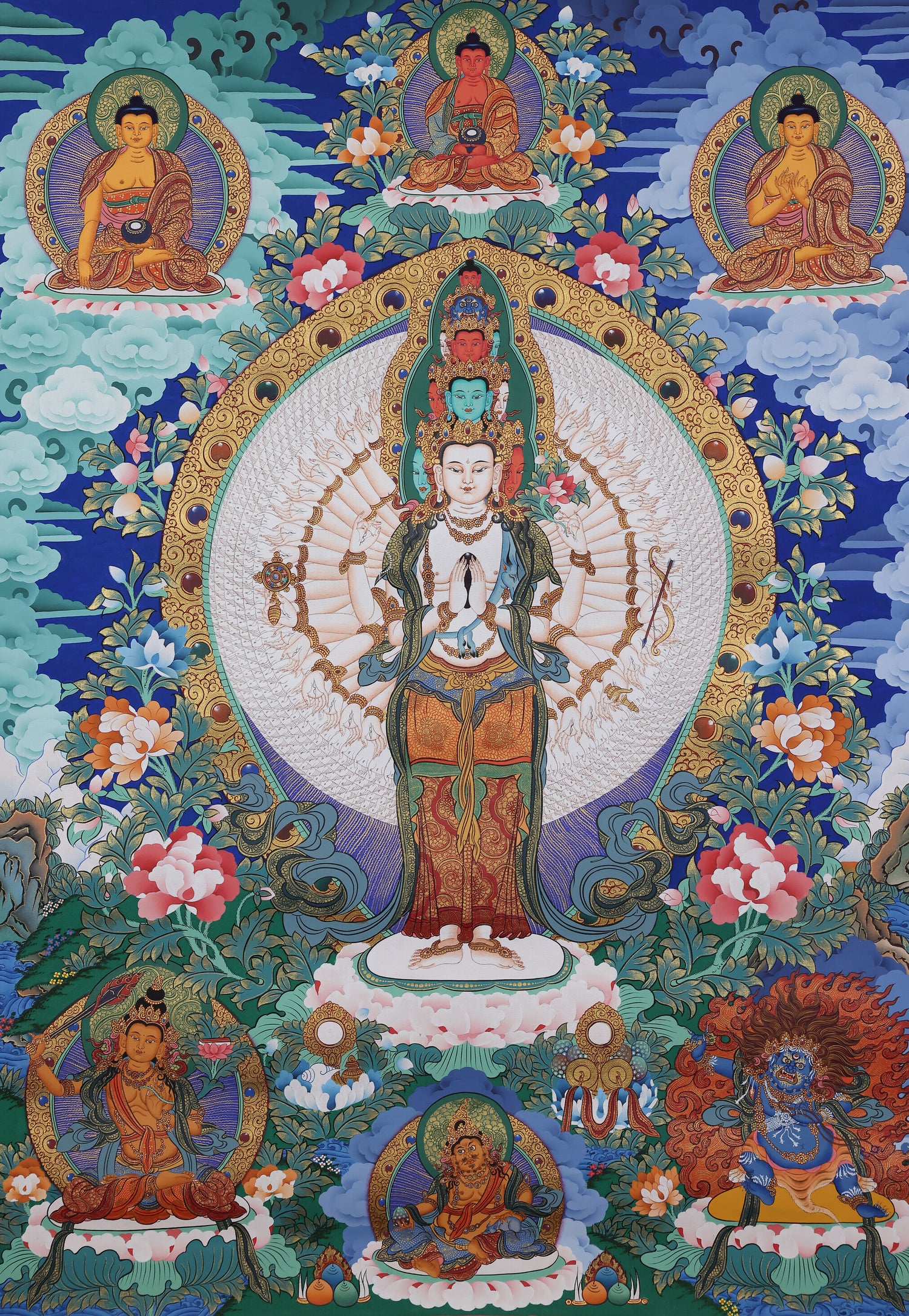
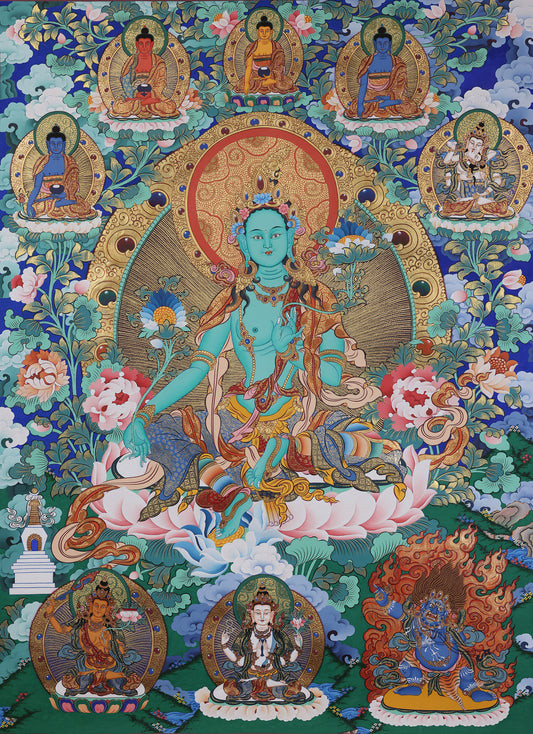
This hand-painted Tibetan Buddhist thangka centers on the sacred theme of Amitabha Buddha’s Pure Land, known as Sukhavati, the Western Pure Land presided over by Amitabha Buddha within the Buddhist Pure Land tradition.
In Tibetan Buddhism, the Pure Land is not merely an imagined “heaven,” but a visual manifestation of the Buddha’s fully realized wisdom realm—a purified field of awakening created through Amitabha Buddha’s vast vows. According to canonical scriptures such as the Amitabha Sutra and the Infinite Life Sutra, Sukhavati is adorned with seven-jeweled pools, eight qualities of virtuous water, jewel trees, celestial music, and boundless radiance. It is a realm designed to help sentient beings swiftly transcend suffering and attain enlightenment.
A distinctive feature of this thangka is its integration of the Nyingma school’s doctrine of the Three Bodies (Trikaya) in Unity:
-
Amitabha Buddha represents the Dharmakaya (truth body)
-
Avalokiteshvara (Chenrezig) represents the Sambhogakaya (enjoyment body)
-
Guru Padmasambhava (Lotus-Born Master) in the lotus pond below represents the Nirmanakaya (emanation body)
Within the Nyingma tradition, rebirth in Guru Rinpoche’s pure realm is considered equivalent to rebirth in Amitabha’s Pure Land. This composition therefore unites Pure Land devotion and Vajrayana lineage practice, reflecting the inclusive and integrative nature of Tibetan Buddhist doctrine.
II. The Central Deity: Iconography and Spiritual Symbolism of Amitabha Buddha
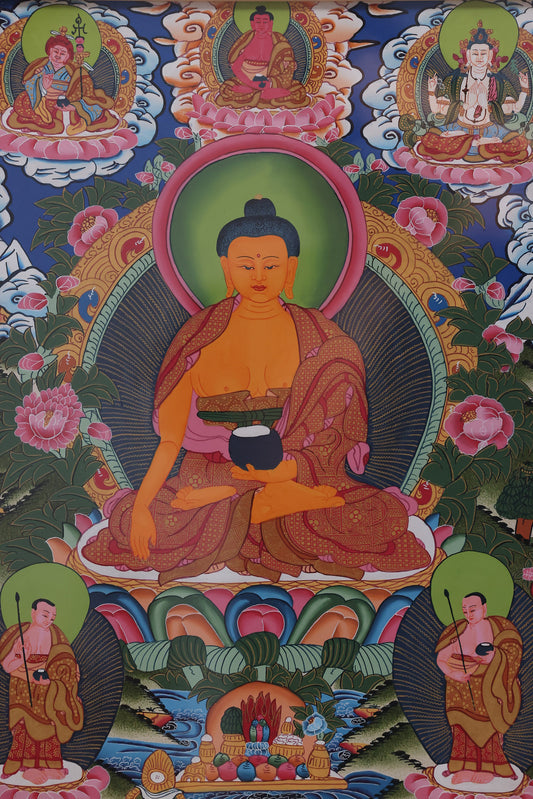
At the center of the composition sits Amitabha Buddha (Tibetan: Tsepakmé), rendered in strict accordance with the classical iconometric standards of the Iconometry Sutras, following the sacred 37:25 golden proportion. Every aspect of the figure carries deep symbolic meaning.
Physical Form and Expression
Amitabha’s high cranial protuberance (ushnisha) symbolizes perfected wisdom, while his long earlobes recall his renunciation of royal life and lifelong cultivation of compassion. His serene facial expression—eyes gently lowered, lips calm and composed—conveys the Pure Land’s essential quality: liberation from afflictive heat and the attainment of cool, peaceful clarity.
His body is depicted in warm orange-red tones, a traditional color for Amitabha in Tibetan thangka art, symbolizing the transformation of attachment into boundless compassion and wisdom within Vajrayana philosophy.
Mudra and Sacred Object
Amitabha’s hands form the Dhyana Mudra (meditation gesture), resting in his lap while holding a begging bowl. The bowl symbolizes both the Buddha’s monastic practice of alms-begging and the deeper meaning of nourishing beings with the Dharma, uniting compassion and emptiness.
Lotus Throne and Halo
The Buddha sits in full lotus posture upon a thousand-petaled lotus throne, representing purity untouched by samsaric defilements. Behind him radiates a double halo:
-
An inner green body halo symbolizing cool, undefiled clarity
-
An outer golden Dharma halo representing the universal radiance of Buddhist truth
The halo is adorned with flowing scroll motifs, a traditional Tibetan method of expressing spiritual merit through ornamentation.
III. The Sacred Assembly: The Hierarchical Structure of Enlightened Beings in the Pure Land
The surrounding figures form a carefully structured sacred assembly, organized according to Tibetan cosmology and spiritual function.
The Western Three Saints
Standing beside Amitabha are Avalokiteshvara (Chenrezig) on the left and Mahasthamaprapta on the right, collectively known as the Three Saints of the Western Pure Land. Avalokiteshvara holds a nectar vase symbolizing the compassionate alleviation of suffering, while Mahasthamaprapta holds a lotus flower, guiding beings toward rebirth in the Pure Land. Their jeweled ornaments and flowing garments signify their status as Sambhogakaya bodhisattvas.
Upper Deities
Above Amitabha appear three of the Five Dhyani Buddhas: Akshobhya (East), Ratnasambhava (South), and Amoghasiddhi (North). Though only three are depicted, they symbolically represent the totality of the Five Wisdoms, expressing the Tibetan artistic principle of “revealing the whole through a part.”
Lower Figures and Lineage Masters
-
Ananda and Mahakashyapa, two of the Buddha’s foremost disciples, represent the ideals of the Śrāvaka path
-
Guru Padmasambhava, seated in the lotus pond, embodies the Nyingma lineage and the emanation body of enlightenment
-
A Four-Armed Avalokiteshvara further reinforces the Trikaya unity
Surrounding them are celestial musicians, offering goddesses, Dharma protectors, and nāgas, creating a vision where enlightened and worldly beings coexist in harmonious devotion.
These figures are not decorative elements; they form a visual map of spiritual progression, guiding practitioners from ordinary existence toward awakening.
IV. Sacred Craftsmanship: Thangka Painting as Both Art and Spiritual Practice
This thangka is a fully hand-painted work in the Menri (Mentang) tradition, renowned for its precise linework and rich coloration. In Tibetan culture, the creation of a thangka is itself a spiritual discipline.
Canvas Preparation
The base is pure cotton cloth, treated through multiple stages of stretching, animal-glue sizing, drying, and polishing. This meticulous process ensures durability for generations and is traditionally regarded as a preparatory purification practice for the artist.
Natural Mineral Pigments
All colors are derived from natural sources: cinnabar red, malachite green, lapis lazuli blue, and finely ground 24K gold. The pigments are crushed to microscopic fineness and bound with natural glue, producing luminous colors that do not fade over centuries, symbolizing the timeless nature of the Dharma.
Painting Techniques
-
Line Drawing: Executed with wolf-hair brushes, lines are hair-thin and applied using the central brush technique, forming the structural “bones” of the image
-
Color Application: Multiple layers are applied from dark to light, creating depth and vitality
-
Eye-Opening Ceremony: The final step, painting the Buddha’s eyes, is performed with ritual purity and deep concentration, embodying the teaching that “the Buddha gazes upon all beings with compassion”
Composition and Perspective
The composition employs a Buddha-centered, non-linear perspective: figures closest to Amitabha appear larger, while more distant figures gradually diminish in scale. This reflects the doctrinal view of the Buddha as the spiritual axis of the universe and creates a vast, resonant spatial rhythm inspired by classical 16th-century Tibetan layouts, subtly blended with Chinese realist garment rendering.
Conclusion: A Living Vessel of the Dharma
This Amitabha Buddha Pure Land Thangka is not merely an artwork—it is a portable Buddhist sanctuary. Its theme visualizes Pure Land faith, its deities embody the stages of realization, and its craftsmanship reflects devotion made visible through form.
In Tibetan culture, thangkas are not static decorations but active supports for meditation, visualization, prostration, and merit accumulation. Every brushstroke, every mineral pigment, carries a prayer that all beings may be freed from suffering and attain peace.
For collectors, practitioners, and devotees seeking a thangka of authentic lineage, profound symbolism, and lasting spiritual value, this hand-painted Amitabha Buddha’s Pure Land thangka stands as a truly exceptional and meaningful work.
#AmitabhaBuddha
#PureLandBuddhism
#Sukhavati
#WesternPureLand
#AmitabhaPureLand
#TibetanBuddhism
#TibetanThangka
#BuddhistThangka
#SacredBuddhistArt
#VajrayanaBuddhism
#BuddhistMeditation
#PureLandPractice
#SpiritualAwakening
#BuddhistDevotion
#CompassionAndWisdo
#HandPaintedThangka
#MineralPigmentArt
#TraditionalBuddhistArt
#MenriThangka
#BuddhistArtCollection