Blog Article: Nepalese Hand-Painted Thangka of Red Amitabha Buddha: Decoding Its Tibetan Buddhist Symbolism, Artistry, and Cultural Roots

$499.00 USD
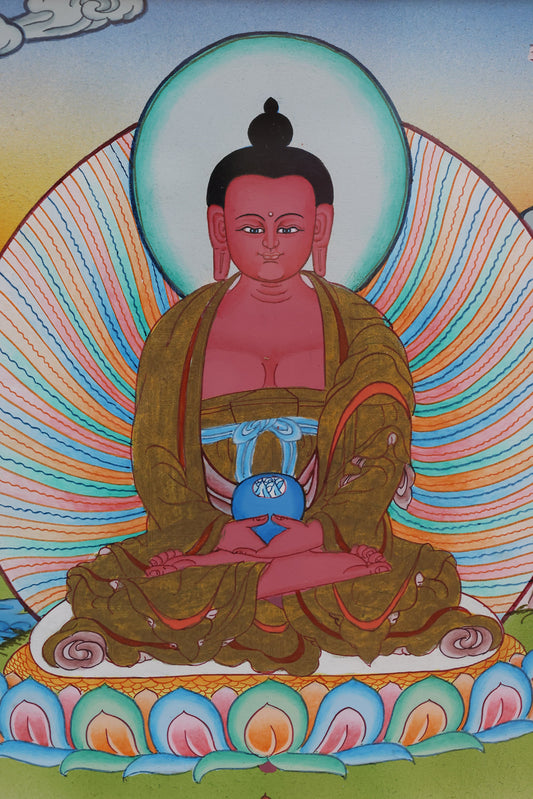
Thangka Name: Amitabha Buddha in colorful robes
size: 25cm×35cm
origin: Nepal
Eine Frage stellen

Beeil dich! Nur noch [Anzahl] auf Lager!

Geschätzte Lieferzeiten: 12–26 Tage (International), 3–6 Tage (USA).

Rückgabe innerhalb von 45 Tagen nach dem Kauf. Zölle und Steuern werden nicht erstattet.

Colorful Tibetan Thangka of Amitabha Buddha, hand-painted in traditional Buddhist art style.
Blog Article: Nepalese Hand-Painted Thangka of Red Amitabha Buddha: Decoding Its Tibetan Buddhist Symbolism, Artistry, and Cultural Roots
$499.00 USD
When you hold a 25x35cm hand-painted Nepalese thangka—its colors still vibrant from mineral pigments, its lines softened by generations of artistic tradition—you’re not just holding a work of art: you’re holding a portable portal to Tibetan Buddhist cosmology. This small scroll, crafted in Nepal using age-old Paubha techniques, centers on one of Tibetan Buddhism’s most revered figures: the Red Amitabha Buddha (also called Amitabha, the Buddha of Infinite Light). Let’s unpack its spiritual symbolism, artistic craft, and cultural roots.

The Theme: A Portal to the Western Pure Land

This thangka’s core theme is rooted in Tibetan Buddhist Pure Land devotion: Amitabha Buddha, the Western Buddha of the Five Dhyani Buddhas, presides over Sukhavati (the Western Pure Land)—a realm free of suffering, where practitioners aspire to be reborn through devotion to Amitabha.

Unlike large temple thangkas (used for public ceremonies), this 25x35cm piece is a personal devotional thangka: designed for individual meditation, daily worship, or travel. Its compact size means the focus stays tightly on Amitabha himself—no distractions, just the Buddha’s form as a focal point for visualization practice (a key Tibetan Buddhist method for cultivating wisdom and compassion).

The Main Deity: Red Amitabha Buddha’s Iconographic Language

Every detail of Amitabha’s form follows the strict rules of Tibetan Buddhist iconography (codified in texts like the Iconometric Sutras), turning aesthetics into spiritual communication:

  1. Body Color & Auspicious Marks: Amitabha’s vivid red body isn’t arbitrary—it symbolizes gentle power and all-encompassing compassion (red is associated with life, warmth, and the Buddha’s ability to “gather” beings into his Pure Land). His face bears the 32 Major Marks of a Buddha: a white curl between his brows (symbolizing wisdom light), long 耳垂 (signs of great merit), and a swastika on his chest (a symbol of eternal well-being, long before its modern misuse).
  2. Mudra & Ritual Object: His hands rest in the Dhyana Mudra (meditation gesture), holding a longevity vase (or kalasha)—a vessel filled with “nectar of enlightenment” that represents Amitabha’s role as the Buddha of Infinite Life (he’s often linked to Amitayus, the Buddha of Longevity, in Tibetan tradition). The vase’s blue hue (from lapis lazuli powder) adds another layer: blue symbolizes spiritual purity in Himalayan art.
  3. Robe & Lotus Seat: He wears a monastic robe (one shoulder bare, a style associated with Buddhist monks) in earthy yellow and ochre—colors that evoke humility and connection to the natural world. He sits on an eight-petaled lotus moon seat: the lotus represents enlightenment (growing pure from muddy waters), while the moon symbolizes the “unstained” nature of the Pure Land.
  4. Auras: A teal nimbus (head halo) frames his face (symbolizing clear wisdom), while a radiating rainbow aura (blue, red, orange) expands outward—this is a signature of Nepalese thangkas (Tibetan thangkas often use simpler, gold-lined auras), representing Amitabha’s light reaching all beings.

Retinue Deities: Simplification for Personal Practice

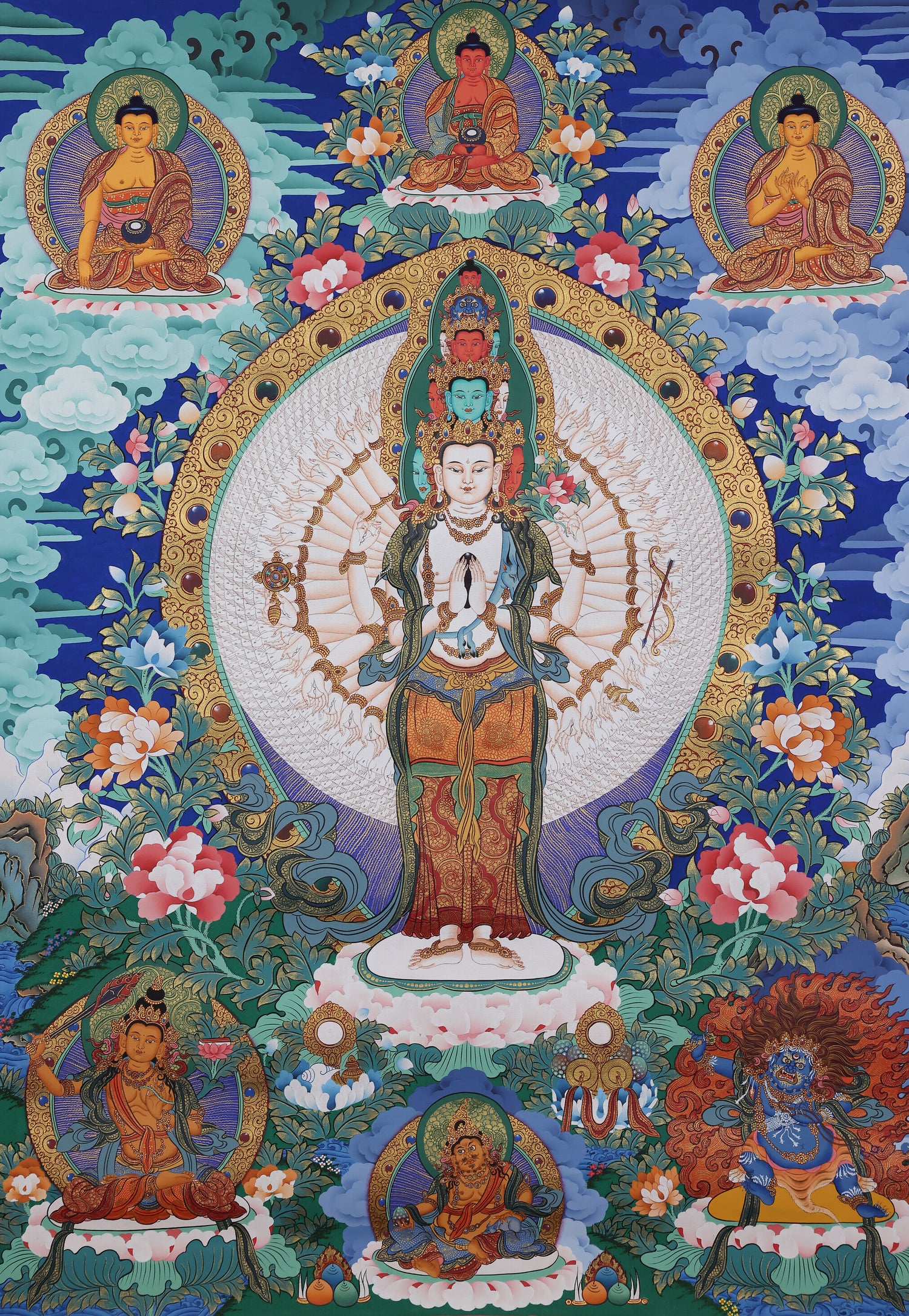
You might notice something missing: the Western Trinity (Amitabha flanked by Chenrezig/Guanyin and Mahasthamaprapta, his traditional attendants). This “solo Buddha” design is intentional:

  • Function first: Small personal thangkas prioritize visualization of the main deity—no need for elaborate retinues when the goal is one-on-one spiritual focus.
  • Size constraints: A 25x35cm canvas can’t accommodate the intricate details of attendant deities (common in larger temple thangkas).
  • Cultural influence: Nepalese thangkas draw from Indian “solitary Buddha” traditions, unlike Tibetan thangkas, which often feature dense, multi-figure compositions.

For a full Western Trinity thangka, you’d need a piece 50cm or larger—but this small scroll’s simplicity is part of its purpose: it’s a companion, not a ceremonial centerpiece.

Craftsmanship: The Paubha Technique (Mineral & Earth Pigments)

This thangka is a masterclass in Nepalese Paubha (the local term for thangka) craftsmanship, using materials that have endured for centuries:

  1. Canvas Preparation:

    Nepalese Paubha artists use fine local cotton, treated with a mix of bone glue and white clay (unlike Tibetan thangkas, which use linen and lime paste). The canvas is smoothed with a seashell until all texture disappears—this creates a surface that holds mineral pigments without bleeding, while remaining lightweight enough for travel.
  2. Pigment Making:

    Every color comes from the earth (or semi-precious stones):
    • Red (Amitabha’s body): A blend of cinnabar (for vibrancy) and red earth (for warmth), ground to a fine powder and mixed with bone glue (to make it water-resistant and fade-proof).
    • Yellow (robe): Realgar (a mineral) and yellow ochre (earth pigment), balanced for a soft, earthy tone.
    • Blue (aura/vase): Lapis lazuli (mined in Afghanistan, traded through Nepal), ground to 200+ mesh for a luminous, deep blue—this is one of the costliest pigments in Himalayan art.
    • White (lotus): Rinbu white clay (from northern Nepal), softer than the conch powder used in Tibetan thangkas.
  3. Painting Process:
    • Linework: First, charcoal lines mark the Buddha’s proportions (120 “finger-widths” tall, per the Iconometric Sutras), then ink lines define the form.
    • Layering: Colors are applied from light to dark (white lotus first, then yellow robe, then red body), with 24-hour drying time between layers to prevent smudging.
    • “Opening the Face”: The final (and most sacred) step: a master artist paints the eyes (slightly upward, to symbolize “watching over all beings”), lips, and brow curl—usually on an auspicious Tibetan calendar day, as Paubha painting is seen as a spiritual practice, not just a craft.

Style: Nepalese Paubha vs. Tibetan Thangka

This thangka’s look sets it apart from Tibetan thangkas—here’s how:

  • Color: Nepalese Paubha uses bright, gradient auras (rainbow hues) instead of Tibetan thangkas’ solid or gold-lined auras, reflecting Indian art’s emphasis on emotional color.
  • Lines: Soft, curved lines (especially in the robe) replace Tibetan thangkas’ sharp, angular lines—an echo of Nepal’s connection to Gandhara (ancient Indian) art.
  • Background: A simple pale blue with cloud motifs (Tibetan thangkas often feature detailed landscapes or palaces) keeps the focus on Amitabha, perfect for a personal devotional piece.

Why This Thangka Matters

This small scroll isn’t just decor: it’s a bridge between art, spirituality, and culture. Its mineral pigments carry the weight of Himalayan geology; its lines follow millenia-old religious rules; its size makes it a companion for daily practice. For Nepalese artists, painting Paubha is a form of devotion; for practitioners, it’s a way to carry the Pure Land with them, wherever they go.
#NepaleseThangka #AmitabhaBuddha #TibetanBuddhistArt #PaubhaPainting #SacredArt #HimalayanArt #BuddhistIconography #MineralPigmentArt
Entdecken Sie das perfekte tibetisch-buddhistische Thangka, das zu Ihren Wünschen, Ihrem Lebensstil und Ihrem Raum passt. Jedes Thangka hat eine spirituelle Bedeutung und bringt Segen, wenn es richtig platziert wird.

1. Definieren Sie Ihre Absicht

Reichtum & Erfolg → Gelber Dzambhala (Gottheit des Reichtums)

Mitgefühl und Frieden → Avalokiteshvara, Grüne Tara

Weisheit & Lernen → Manjushri

Gesundheit & Heilung → Medizinbuddha

Langlebigkeit und Familienschutz → Weiße Tara

2. Wählen Sie nach Identität

Unternehmer und Geschäftsinhaber → Reichtumsgottheiten für Wohlstand.

Studenten und Gelehrte → Weisheitsgottheiten für Konzentration und Klarheit.

Heiler und Yoga-Praktizierende → Medizinbuddha für Energie und Gleichgewicht.

Familien und Hausfrauen → Tara-Gottheiten für Harmonie und Sicherheit.

Sammler und Kunstliebhaber → Seltene Mandalas oder Meisterwerk-Thangkas.

3. Passen Sie Ihren Raum an

Heimschrein / Meditationsraum → Mittlere Thangkas (60–80 cm).

Büro / Geschäftshalle → Große Thangkas für Wohlstand und Autorität.

Wohnzimmer / Arbeitszimmer → Dekorative Thangkas für Frieden und Schönheit.

4. Authentische Handwerkskunst

Jedes Thangka ist mit natürlichen Mineralpigmenten und feiner Leinwand handbemalt und spiegelt tibetische Kunstfertigkeit und spirituelle Kraft wider. Überprüfte Quellen gewährleisten Qualität und Respekt für die Tradition.

✨ Wählen Sie Ihr Thangka mit Herz – es ist nicht nur Kunst, sondern ein Segen für Ihr Leben.

Jeder Mensch hat unterschiedliche Bedürfnisse. Die Wahl des richtigen Thangkas kann spirituelle Unterstützung, Schutz, Glück und Segen bieten. Nachfolgend finden Sie Thangka-Empfehlungen für verschiedene Rollen:

1. Unternehmer

  • Bedürfnisse : Weisheit, Reichtum, Gesundheit, beruflicher Erfolg.
  • Empfohlene Thangkas :
    Manjushri : Verbessert die Entscheidungsfindung und Geschäftsweisheit.
    Gottheit des Reichtums : Bringt Reichtum und Wohlstand.
    Medizinbuddha : Unterstützt die Gesundheit und reduziert Stress.
    Mahakala : Schützt Unternehmen vor Konkurrenz und Herausforderungen.

2. Erfolgreiche Einzelpersonen

  • Bedürfnisse : Innerer Frieden, Familienharmonie, Langlebigkeit.
  • Empfohlene Thangkas :
    Amitabha Buddha : Bringt inneren Frieden und Ruhe.
    Avalokiteshvara (Guanyin) : Fördert Harmonie und Glück in der Familie.
    Amitayus (Langlebens-Buddha) : Betet für gute Gesundheit und ein langes Leben.
    Manjushri : Stärkt weiterhin die Weisheit.

3. Hausfrauen/Ehemänner

  • Bedürfnisse : Familienharmonie, Schutz, Gesundheit.
  • Empfohlene Thangkas :
    Avalokiteshvara : Steigert das Familienglück und die Harmonie.
    Schutzgottheiten : Beschützen die Familie vor äußeren Störungen.
    Weiße Tara : Segnet die Familie mit Gesundheit.

4. Studierende und Wissenschaftler

  • Bedürfnisse : Weisheit, Konzentration, akademischer Erfolg.
  • Empfohlene Thangkas :
    Manjushri : Fördert Lernfähigkeit, Gedächtnis und Weisheit.
    Shakyamuni Buddha : Hilft bei der Konzentration und spirituellen Praxis.
    Jixiang Tianmu : Bringt akademisches Glück und Prüfungserfolg.

5. Künstler und Kreativprofis

  • Bedürfnisse : Inspiration, Kreativität, künstlerische Leistung.
  • Empfohlene Thangkas :
    Manjushri : Regt kreatives Denken und Inspiration an.
    Vajrapani : Hilft, kreative Blockaden zu überwinden.
    Maitreya : Sorgt für eine entspannte und optimistische Einstellung und baut Stress ab.

6. Reisende und Abenteurer

  • Bedürfnisse : Schutz, Glück, Erfolg bei Abenteuern.
  • Empfohlene Thangkas :
    Hayagriva : Bietet starken Schutz auf Reisen und beseitigt Hindernisse.
    Mahakala : Bringt Glück und Schutz, insbesondere für Abenteurer.
    Vajrasattva : Hilft, Schwierigkeiten und Herausforderungen während der Reise zu überwinden.

7. Ältere Menschen

  • Bedürfnisse : Gesundheit, Langlebigkeit, spiritueller Frieden.
  • Empfohlene Thangkas :
    Amitayus : Betet für ein langes Leben und gute Gesundheit.
    Medizinbuddha : Fördert Heilung und körperliches Wohlbefinden.
    Avalokiteshvara : Bringt Mitgefühl und inneren Frieden in späteren Jahren.

8. Führungskräfte

  • Bedürfnisse : Führung, Weisheit, Teamarbeit und geschäftlicher Erfolg.
  • Empfohlene Thangkas :
    Manjushri : Verbessert Führungsqualitäten und Entscheidungsfindung.
    Gottheit des Reichtums : Bringt dem Unternehmen und dem Team Erfolg und Wohlstand.
    Avalokiteshvara : Fördert Harmonie und Gleichgewicht innerhalb des Teams.

9. Gesundheits- und Fitnessbegeisterte

  • Bedürfnisse : Gute Gesundheit, Vitalität, Energie.
  • Empfohlene Thangkas :
    Medizinbuddha : Verbessert die körperliche Gesundheit und Vitalität.
    Weiße Tara : Bringt Gesundheit und Verjüngung.
    Vajrasattva : Beseitigt gesundheitliche Probleme und steigert die Energie.

10. Politiker

  • Bedürfnisse : Führung, Weisheit, Frieden.
  • Empfohlene Thangkas :
    Manjushri : Verbessert Führungsqualitäten und Entscheidungsfindung.
    Vairocana Buddha : Hilft, inneren Frieden und Weisheit zu bewahren.
    Avalokiteshvara : Fördert den gesellschaftlichen Frieden und die Harmonie in der Familie.

Für alle Bestellungen über 100 USD ist der Versand kostenlos.

Rücksendungen werden bis zu 10 Tage nach Erhalt des Kaufbelegs bzw. der Sendungsnummer (bei ungetragenen Artikeln) akzeptiert. Sie als Kunde sind verpflichtet, uns vor der Rücksendung des Artikels per E-Mail zu informieren.

Andernfalls fallen die Standardversandkosten an. Weitere Informationen finden Sie in unseren Lieferbedingungen .

Rücksendungen werden bis zu 10 Tage nach Erhalt des Kaufbelegs oder der Sendungsnummer (bei ungetragenen Artikeln) akzeptiert. Sie als Kunde sind verpflichtet, uns vor der Rücksendung des Artikels per E-Mail zu informieren, nur in folgenden Fällen:

– Den falschen Artikel erhalten.
– Artikel kam nicht wie erwartet an (z. B. beschädigte Verpackung).
– Artikel hatte Mängel.
– Über die Lieferzeit hinaus.
– Der Spediteur gestattet keine Besichtigung der Ware vor der Bezahlung.

Die zurückgesendeten Produkte müssen in der Originalverpackung, sicher verpackt, unbeschädigt und ungetragen sein. Dies bedeutet, dass die Artikel zum Schutz während des Transports sicher in einem Karton verpackt sein müssen, möglichst im selben Karton, in dem sie an Sie als Kunde versendet wurden.

Kürzlich angesehen

Nicht vergessen! Die Produkte, die Sie angesehen haben, legen Sie jetzt in den Warenkorb.

Passt gut zu

Erweitern Sie Ihre Auswahl mit perfekt abgestimmtem Zubehör und ergänzenden Produkten.

Leute kauften auch

Hier sind einige unserer ähnlichsten Produkte, die die Leute kaufen. Klicken Sie hier, um den Trendstil zu entdecken.