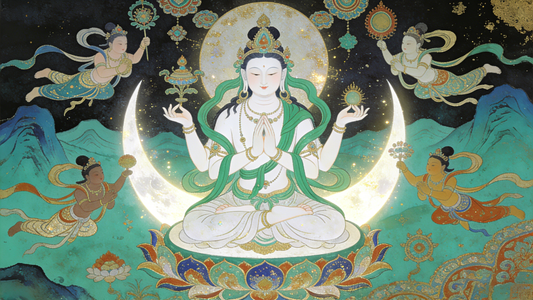
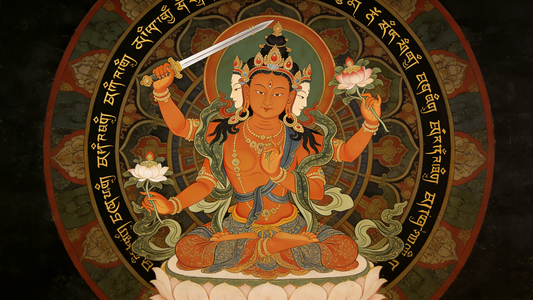
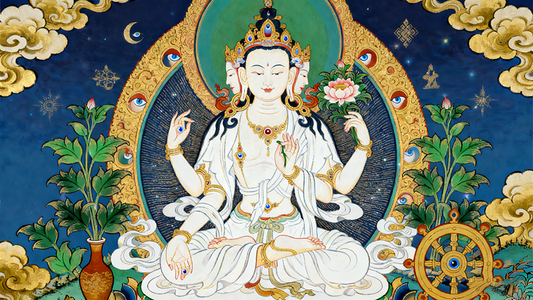
In the lineage of Tibetan Buddhism, Tara is revered as the "Compassionate Goddess Who Saves Beings from Suffering". Her compassionate vows extend across the six realms, manifesting specifically to free all sentient beings from afflictions and fulfill both worldly and transcendental aspirations. The Tara Mantra—"Om Tare Tuttare Ture Soha"—serves as the core link connecting practitioners to Tara’s compassionate energy, embodying boundless blessings. For spiritual seekers, reciting the Tara Mantra is not only a meritorious practice to accumulate positive karma but also a practical path to attain inner peace and break through adversities. This article will elaborate on the merits and benefits of the Tara Mantra, and provide actionable recitation methods, visualization techniques, and daily practice suggestions, helping beginners get started quickly and advanced practitioners deepen their spiritual experience.
Before delving into practical practice, it is essential to comprehend the meaning and lineage origin of the Tara Mantra. Tara is an emanation of Amitabha Buddha and a manifestation of Avalokiteśvara Bodhisattva’s compassion. According to legend, when Avalokiteśvara Bodhisattva was striving to save sentient beings, he witnessed the profound sufferings of all creatures and shed tears of compassion. One drop of his tear transformed into Green Tara, who then manifested as the Twenty-One Taras, each taking charge of different karmic conditions for delivering beings. The Tara Mantra is the condensation of Tara’s compassionate vows and wisdom; every syllable corresponds to a specific energy frequency, capable of awakening the compassion and power inherent in practitioners.
In terms of pronunciation:
- "Om" is the fundamental sound of the universe, representing the purification and unification of body, speech, and mind. Reciting this syllable can awaken the seed of Buddhahood within.
- "Tare" means "liberation", symbolizing freedom from the ocean of samsara and the eradication of afflictions and attachments.
- "Tuttare" means "swift liberation", signifying rapid deliverance from dangers and the removal of obstacles.
- "Ture" means "accomplishment", representing the fulfillment of all virtuous aspirations and the attainment of ultimate wisdom.
- "Soha" is the conclusion of vows and accomplishments, meaning "thus be it", symbolizing perfect alignment with Tara’s compassionate vows.
In the Buddhist lineage, the blessings of the Tara Mantra are not superstition but the verified results of generations of practitioners. Whether one seeks worldly peace, health, career success, or transcendental spiritual progress and enlightenment, reciting the Tara Mantra can provide powerful support. This is why it is hailed as "the most suitable spiritual practice for modern people"—simple to recite, requiring no complicated rituals, yet capable of quickly connecting practitioners to compassionate energy.
The merits of the Tara Mantra cover both worldly and transcendental dimensions, fulfilling practitioners’ legitimate aspirations for daily life while facilitating their journey toward ultimate liberation. Below are the most essential merits and benefits as recorded in Buddhist scriptures and verified through practice, for practitioners’ reference and contemplation:
This is the most direct and widely known merit of the Tara Mantra. Tara is honored as the "Tara Who Saves Beings from Suffering and Peril", excelling particularly in relieving sentient beings from urgent hardships and obstacles. Whether facing accidental dangers in daily life (such as traffic accidents, natural disasters), conflicts in interpersonal relationships, or bottlenecks in spiritual practice (such as drowsiness, distraction, interference from demonic obstacles), reciting the Tara Mantra with sincerity will invoke Tara’s blessings, turning danger into safety and breaking through hindrances.
Buddhist scriptures record that if someone is facing life-threatening peril, reciting the Tara Mantra with utmost sincerity will prompt Tara to manifest instantly and protect them from harm. For modern people, "dangers" are more commonly reflected in work pressure, family conflicts, health risks, etc. Long-term recitation of the mantra can gradually dissolve inner anxiety and attachments, creating opportunities to resolve problems—this is the worldly manifestation of "removing obstacles".
Tara’s compassionate vows are vast; as long as practitioners recite and pray with a pure mind, all legitimate virtuous aspirations (such as seeking health, career advancement, harmonious relationships, or children) will receive blessings and responses. The "fulfillment of virtuous aspirations" here does not mean "gaining something for nothing". Instead, Tara’s energy will help practitioners unlock karmic conditions, making their efforts more likely to yield fruitful results.
For example, for those hoping to improve their health, reciting the mantra can help regulate physical and mental states, enhance immunity, and when combined with a reasonable daily routine and diet, facilitate faster recovery. For those pursuing career development, the blessings of the mantra will help them maintain clear thinking, reduce decision-making errors, and attract the support of noble people. It is important to note that when praying, one should avoid selfish motivations. If aspirations are based on "benefiting all sentient beings" (e.g., "May my career thrive so that I have the ability to help more people"), the merits will be more profound, and virtuous aspirations will be more easily fulfilled.
The root cause of sentient beings’ sufferings and afflictions lies in past karmic obstacles and habitual tendencies. The Tara Mantra possesses powerful purifying energy; during recitation, the mantra’s vibrations will gradually cleanse the karmic obstacles of practitioners’ body, speech, and mind, reducing the influence of negative emotions and harmful habits. Meanwhile, recitation itself is a process of accumulating merit and wisdom—every sincere recitation accumulates positive karma for oneself and all sentient beings, laying a solid foundation for the spiritual path.
For individuals with heavy karmic obstacles, it is possible to experience "increased afflictions in the initial stage of recitation". This is not a sign of insufficient blessings but a normal phenomenon where the mantra’s energy stirs up karmic obstacles, bringing them to the surface for purification. At such times, practitioners should persist in recitation while maintaining a repentant and compassionate heart. Once karmic obstacles are purified, they will clearly feel inner purity and peace.
Tara is not only the "Goddess Who Saves Beings from Suffering" but also the "Mother of Wisdom". Her blessings can help practitioners awaken inherent prajna wisdom and dispel ignorance and attachments. Long-term recitation of the Tara Mantra will calm and sharpen the mind, making it easier to comprehend the core principles of Buddhism and achieve breakthroughs in meditation and visualization practices.
For beginners, reciting the mantra is an excellent way to cultivate concentration—by focusing on pronunciation and rhythm, scattered thoughts can be quickly gathered, paving the way for advanced spiritual practice. For experienced practitioners, the mantra can help them align with Tara’s wisdom during practice, transcend the limitations of the mind, and draw closer to the state of realizing one’s true nature.
Tara’s compassionate vow is to "benefit all sentient beings". Therefore, if practitioners recite the Tara Mantra with the bodhicitta of "self-benefit and benefit for others" (i.e., "May the merits from my recitation be dedicated to all sentient beings, may they be freed from suffering, attain happiness, and ultimately achieve Buddhahood"), they will not only accumulate positive karma for themselves but also benefit countless sentient beings. This kind of motivation will continuously enhance practitioners’ compassion, help them form positive karmic connections, and foster more harmonious interpersonal relationships.

After understanding the merits of the Tara Mantra, it is more important to integrate it into daily spiritual practice. Below is a practical guide tailored for beginners, including recitation methods, visualization techniques, practice time arrangements, and precautions. It is simple and easy to follow, suitable for long-term adherence.
Standard pronunciation of the Tara Mantra (Tibetan Buddhist lineage): Om Tare Tuttare Ture Soha
Pronunciation tips:
- "Om": Pronounce it slowly, similar to "Ohm". Touch the tip of the tongue lightly to the palate and feel the vibration in the chest.
- "Tare": Pronounce "Ta" clearly, and "Re" with a slight retroflex, light and forceful.
- "Tuttare": Stress the pronunciation of "Tu", and follow the rhythm of the previous "Tare" without dragging it out.
- "Ture": Pronounce it fully, with a slight upward inflection at the end.
- "Soha": Pronounce "So" briskly and "Ha" loudly, ending crisply—symbolizing "the fulfillment of vows".
Beginners do not need to pursue absolute perfection in pronunciation; the key is to enunciate clearly and focus the mind. If possible, listen to audio recordings of lineage masters reciting the mantra, imitate the rhythm and intonation, and it will be easier to resonate with the blessings.
The posture for reciting the Tara Mantra is flexible; practitioners can choose according to their own conditions, with the core principle of "keeping the body upright and the mind undistracted":
- Sitting posture (recommended): Sit cross-legged (full lotus, half lotus, or simple cross-legged position) or on a chair, keep the back straight, shoulders relaxed, form the Tara Mudra with hands (palms facing up, right hand resting on the left hand, thumbs touching lightly, placed in front of the lower abdomen), close the eyes slightly or gaze forward, focusing on breathing and the mantra.
- Standing/walking posture: For those with busy schedules, recite the mantra while walking or waiting in line. Keep the body upright, focus the mind, and avoid reciting perfunctorily while doing other things (distracted recitation yields minimal merit).
Beginners are advised to set a fixed number of recitations to avoid "casual practice" that is difficult to sustain. Recommended initial quantity: 108 recitations per day (in Tibetan Buddhism, 108 represents the elimination of 108 types of afflictions). Once proficient, gradually increase the number to 216, 432, or 1080 recitations per day.
Counting tools: Use a mala (prayer beads) with 108 beads—move one bead forward for each recitation, cycling repeatedly. Alternatively, use mobile apps (such as "Buddhist Practitioner" or "Spiritual Practice Timer") to assist with counting, which is convenient and efficient.
Dedication of merits: After completing the recitation, it is necessary to dedicate the merits (i.e., share the merits from recitation with all sentient beings) to prevent the merits from "dissipating". Simple dedication prayer: "May all the merits from my recitation of the Tara Mantra today be dedicated to all sentient beings in the six realms. May they be freed from suffering, attain happiness, and ultimately achieve Buddhahood." If you have specific aspirations (e.g., praying for a family member’s health), you can add: "At the same time, dedicate these merits to [Name], may he/she enjoy good health and be free from illness."
For practitioners with a certain foundation, visualization can be incorporated into recitation to concentrate the mantra’s blessings more effectively. The core of visualization is "clarity, reverence, and non-attachment". Beginners do not need to strive to "see Tara’s form"; the focus should be on cultivating faith and compassion.
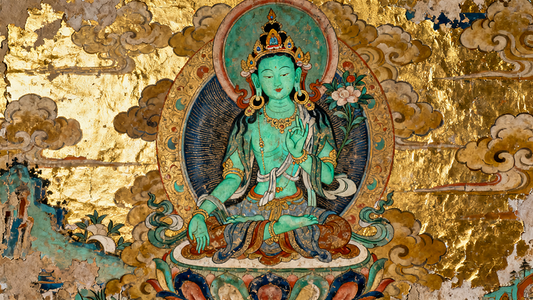
Before recitation, calm the mind for 3–5 minutes and regulate breathing until it is steady. Then visualize Green Tara (the principal form of Tara, representing compassion and blessings) above your head, about one arm’s length away:
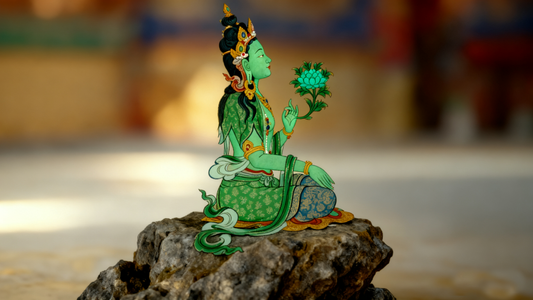
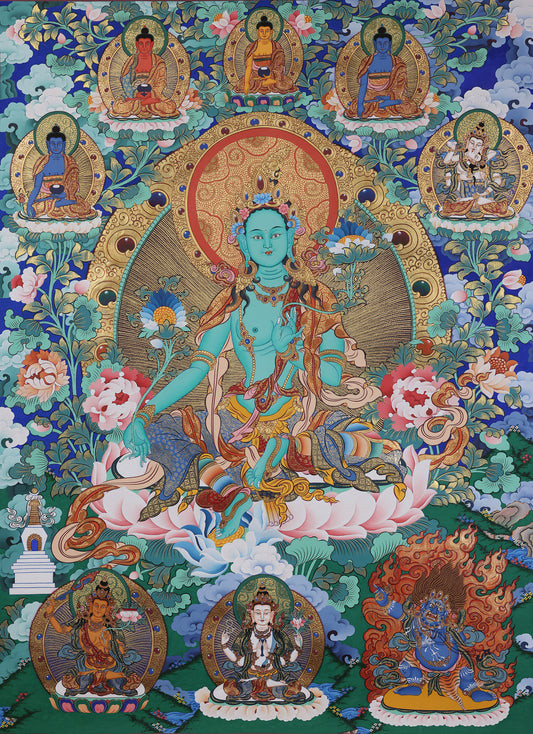
- Appearance: Green Tara has a body as green as jade, with a compassionate and gentle facial expression. Her eyes gaze upon you and all sentient beings. She wears celestial garments and jewelry, holds a lotus in her left hand (symbolizing purity and non-staining), and forms the Varada Mudra (palm facing downward, fingers hanging naturally, symbolizing granting happiness to sentient beings) with her right hand.
- Radiance: Visualize soft green light emanating from Green Tara’s entire body, enveloping you, permeating every cell of your body, purging physical illnesses and negative energy, and bringing purity and peace.
- Connection: As you recite the mantra, visualize Green Tara reciting the same Tara Mantra from her mouth. The sound and radiance of the mantra merge into one, and with each recitation, they integrate into your body and mind, blessing you to remove obstacles and fulfill virtuous aspirations.
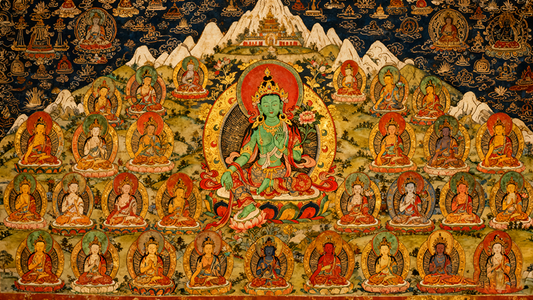
If visualization is not clear, you can first look at images or thangkas of Green Tara to familiarize yourself with her form before practicing visualization. Avoid forcing yourself to imagine, as this may lead to mental distraction.
Once you are proficient in visualizing Green Tara’s form, you can further practice "compassion visualization". While reciting the mantra, visualize Green Tara’s compassionate light not only enveloping you but also spreading throughout the entire room, city, country, and even the six realms of samsara. Wherever the light reaches, the sufferings of all sentient beings gradually dissolve, and smiles of joy appear on their faces. Through this visualization, cultivate the bodhicitta of "self-benefit and benefit for others", making the merits of recitation more vast.
The key to spiritual practice is "long-term persistence", not "occasional intensive practice". For busy modern people, there is no need to pursue "long hours of high-intensity recitation"; instead, integrate the Tara Mantra into daily life to form a stable practice habit. Below are specific suggestions:
Choose the time of day that is easiest to stick to, such as right after waking up in the morning (the mind is relatively pure on an empty stomach) or before going to bed at night (helps relax the body and mind and improve sleep quality). Practice for 15–30 minutes each time, focusing on recitation and visualization. Avoid reciting immediately after meals (blood concentrates on digestion, making the mind prone to distraction).
Incorporate recitation into fragmented moments, such as walking, waiting in line, doing housework, or commuting. Practice "silent recitation" (moving the lips slightly or reciting only in the mind), 10–20 times each time, keeping the mind focused. This not only makes full use of time but also keeps the mind in a state of "purity and compassion" at all times.
Set up a simple practice corner at home, placing a statue (or image) of Green Tara, a butter lamp (or lotus lamp), and a cup of clear water to create a pure and reverent atmosphere. During practice, stay away from distractions such as mobile phones and televisions to better concentrate the mind.
- Mental distraction: The most common issue for beginners is "wandering thoughts during recitation". When this happens, do not feel anxious or forcefully suppress the thoughts; simply gently guide the mind back to the pronunciation of the mantra. Like "herding a cow", patiently lead the mind back, and over time, distraction will naturally decrease.
- Lack of response: Some practitioners may give up because they "do not experience obvious responses after reciting for a period of time". Responses vary from person to person, and the accumulation of merits is subtle and gradual. As long as you persist in reciting with a pure mind, even without "miraculous responses", the inner peace and reduction of afflictions are tangible blessings.
- Fatigue/laziness: If you feel tired from practice, you can appropriately reduce the number of recitations or switch to "silent recitation + visualization", focusing on "mental concentration" rather than "quantity of recitations". If laziness arises, read more stories of Tara’s responses and teachings from lineage masters to strengthen faith and motivation.
For readers who feel connected with Tara mantra practice, a simple visual support can make daily recitation more focused and meaningful. A Green Tara thangka, White Tara image, Tara statue, mala, or hand-painted Tara pendant can serve as a quiet reminder of compassion, protection, healing, and steady practice.
If you are creating a meditation corner or home altar, begin with one clear focal object rather than many items. Choose a Tara image or object that helps you return to the mantra with sincerity: Om Tare Tuttare Ture Soha.
These objects are not a substitute for sincere practice. Their value is to support attention, reverence, and continuity, helping the practitioner return again and again to compassion in daily life.
Finally, it is important to emphasize that the power of the Tara Mantra does not come from an "external deity", but from the compassion and faith within practitioners. Tara is like a mirror; through reciting the mantra, we can see our inherent brightness and power, gradually dispelling afflictions and transcending attachments.
For beginners, there is no need to pursue "quick responses" or "advanced states". Simply start with the simple practice of "108 recitations per day", approaching each session with reverence and compassion. Over time, you will find that not only are obstacles in life gradually diminishing, but your heart is also becoming increasingly calm, gentle, and powerful—this is the most authentic blessing of the Tara Mantra.
Om Tare Tuttare Ture Soha!