Tibetan Hand-Painted Thangka | Manjushri Wisdom Mandala: The Underrated "Portable Wisdom Sanctuary"
wudimeng-Nov 28 2025-
0 comments
Have you ever seen an artwork that weaves "dispelling ignorance and attracting good fortune" into every detail?
This hand-painted Manjushri Wisdom Mandala Thangka isn’t just a decorative piece—it’s a spiritual vessel centered on "wisdom" in Tibetan Buddhism, and a cultural treasure that infuses any space with a "pure aura." Today, we’ll break down the "beauty and spirit" of this thangka and explain why discerning collectors are rushing to acquire hand-painted thangkas.
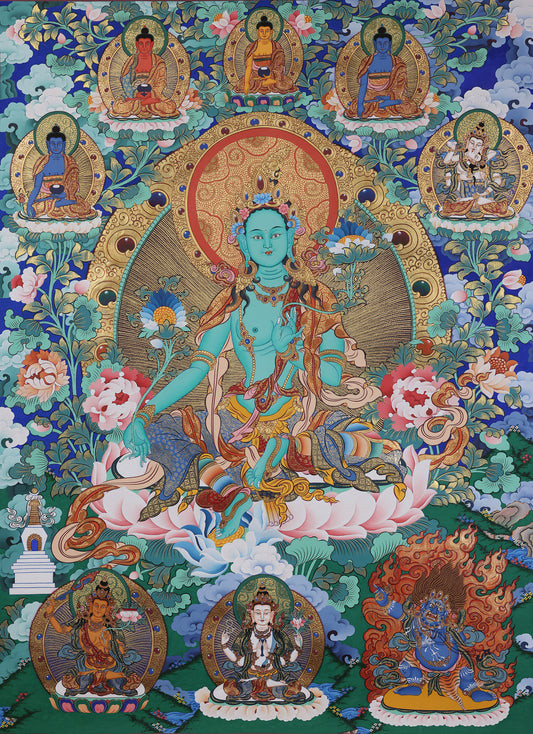
At the center of the painting is the Four-Armed Yellow Manjushri Bodhisattva, the most iconic manifestation of wisdom in Tibetan Buddhism:
- His golden-yellow form (like being wrapped in sunlight) symbolizes "wisdom’s radiant light" in Tibetan culture—said to clear the "mental clutter" from one’s mind.
- Each of his four arms holds a symbolic ritual tool: the Wisdom Sword in his right hand cuts through "ignorance and afflictions"; the Lotus + Sutra Box in his left hand represents the Prajnaparamita Sutra (the root of wisdom); even the bow and arrow signify "piercing through delusion."
- His gentle, compassionate smile isn’t ordinary—it reflects the serenity of "seeing the nature of suffering." This is why Tibetans worship Yellow Manjushri to seek clarity in studies and careers.
The main figure isn’t the only highlight—the "corner attendants" are the hidden gems: they’re Manjushri’s "wisdom retinue," each with a distinct role:
- Top left (Red Manjushri) + Top right (Blue/Black Manjushri): Red Manjushri embodies "attracting good karma," while Blue/Black Manjushri specializes in "dispelling obstacles"—together, they double down on wisdom’s power.
- Bottom left (White Manjushri/Vaishravana Devi) + Bottom right (Lion-Riding Protector): White Manjushri fosters "Bodhicitta (the mind of enlightenment)," while the lion-riding protector (in a wrathful form) "guards wisdom." Even the lion symbolizes "subduing afflictions"—the attention to detail is unparalleled.
Printed thangkas are common, but the "soul" of a hand-painted piece can’t be replicated by machines:
- Artists follow strict Tibetan Buddhist rituals: Every color (e.g., the main figure’s gold, the green nimbus) carries religious meaning—no random brushstrokes.
- The "Tibetan luxury" of black background + gold patterns: The black base makes colors pop, while gold clouds symbolize "celestial clouds of the Buddha’s realm," wrapping your space in a "pure sanctuary."
- It’s more than decor: Tibetans view thangkas as "portable Buddha-lands," and this Manjushri mandala feels like bringing a "field of wisdom" home. Whether displayed in a study for focus or a living room for positive energy, it carries profound cultural weight.
- Professionals wanting a "wisdom boost" in their study/studio: Manjushri brings clarity—even brainstorming feels smoother near it.
- Collectors of Tibetan culture: The hand-painted craftsmanship + full mandala composition make it a "standard premium piece" of Tibetan thangka art.
- Anyone gifting a meaningful present: Unlike generic decor, a thangka is a "blessed cultural treasure"—those in the know recognize its true value.
Pro Tip: Keep hand-painted thangkas in dry, ventilated areas (avoid humidity) — it will grow more spiritually resonant as it ages.
This Manjushri Wisdom Mandala Thangka is a dual winner of "beauty" and "meaning": it blends the artistic dynamism of Tibetan hand-painting with the blessing of "wisdom dispelling obstacles."