This Hand-Painted Thangka Hides the Pure Blessings of the Buddha’s "Dharma Teaching & Liberation"
wudimeng-Nov 29 2025-
0 comments
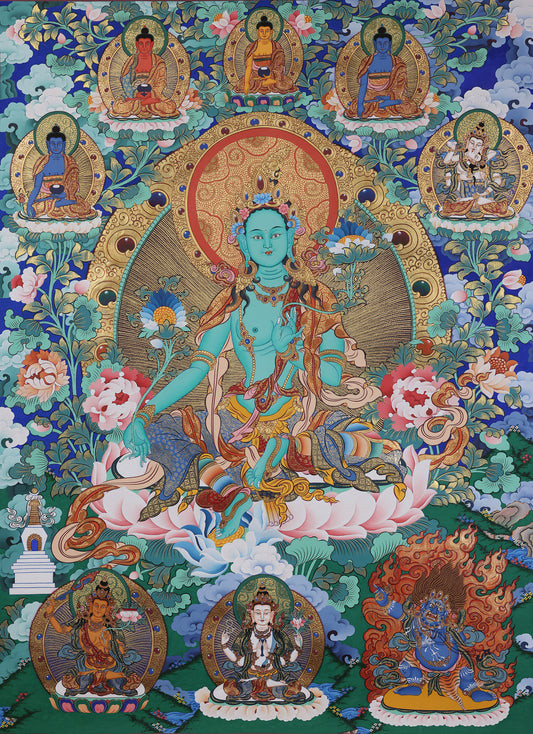
When you gaze at this hand-painted thangka, you’re not just looking at a vivid religious artwork—it’s a visual vessel of Tibetan Buddhism’s "Dharma propagation + pure protection," where every detail is a wish for wisdom and auspiciousness.
At the absolute center of the piece is the Buddha (most likely Shakyamuni Buddha or Medicine Buddha), and his design fundamentally anchors the theme of "teaching and protection":
-
Posture & Ritual Implements: Seated cross-legged on a lotus throne (the lotus symbolizes purity and freedom from defilement), he holds a Dharma wheel (or medicine vase) in his hands—the Dharma wheel represents "the Buddha’s teaching, breaking through afflictions," while the medicine vase corresponds to "healing body and mind," directly conveying the core of "universal Dharma salvation and peace of body and mind."
-
Form & Aura: His warm yellow form (symbolizing compassionate light) is paired with a radiant nimbus (head and body halos), which not only highlights the Buddha’s sacred status but also makes the imagery of "pure energy" more tangible.
The composition of this thangka is a complete "Dharma system":
The two Buddhas (red and blue) at the top correspond to "other-worldly Buddhas/past Buddhas" (such as Akshobhya Buddha of the East and Amitabha Buddha of the West)—their arrangement around the central deity is not decorative, but a symbol of "multi-dimensional Buddhist protection": your physical and mental well-being, and growth in wisdom, are supported by the power of the entire Buddhist realm.
The two monks (holding staffs and ritual implements) flanking the central deity are the Buddha’s core disciples (such as Ananda and Mahakasyapa)—their presence transforms the "Buddha’s teaching" from a "sacred ritual" into a "lineage passed down between master and disciple": the Dharma is not an unreachable doctrine, but wisdom that can reach your life through transmission.
The auxiliary elements of the thangka translate "religious meaning" into a tangible sense of "worldly auspiciousness":
-
Flowers & Clouds: Peonies (prosperity) and lotuses (purity) wrap around the figure, with auspicious clouds lingering in the background—these patterns aren’t just beautiful; they’re direct metaphors for "smooth life and pure body and mind."
-
The Warmth of Color: The contrast between the warm yellow central deity and the blue-red background preserves the traditional opulence of thangkas while using color layering to convey a mood of "warmth and stability." When hung in a space, it exudes a natural "calming aura."
Not all "Buddha paintings" qualify as thangkas:
-
The "Devotional Warmth" of Hand-Painting: Artists use mineral pigments (gold powder, cinnabar, turquoise powder) to paint each stroke and layer by hand—every line and hue carries the "focus of craftsmanship and the piety of faith" a quality machine-printed art can never replicate.
-
More Than Decoration: A "Living Protection": In Tibet, Buddha thangkas are "guardians of the home and soul"—hanging one in your study or tea room is not just an artistic choice, but a way to "integrate the purity and wisdom of the Dharma into daily life."
The most touching thing about this thangka is that it doesn’t portray the Buddha as an unreachable deity—through its form, structure, and details, it tells you: the Buddha’s blessings are "worldly stability," "pure body and mind," and "growth in wisdom."
If you want to let "purity and auspiciousness" enter your life through art, this hand-painted Buddha thangka may be the warmest choice.